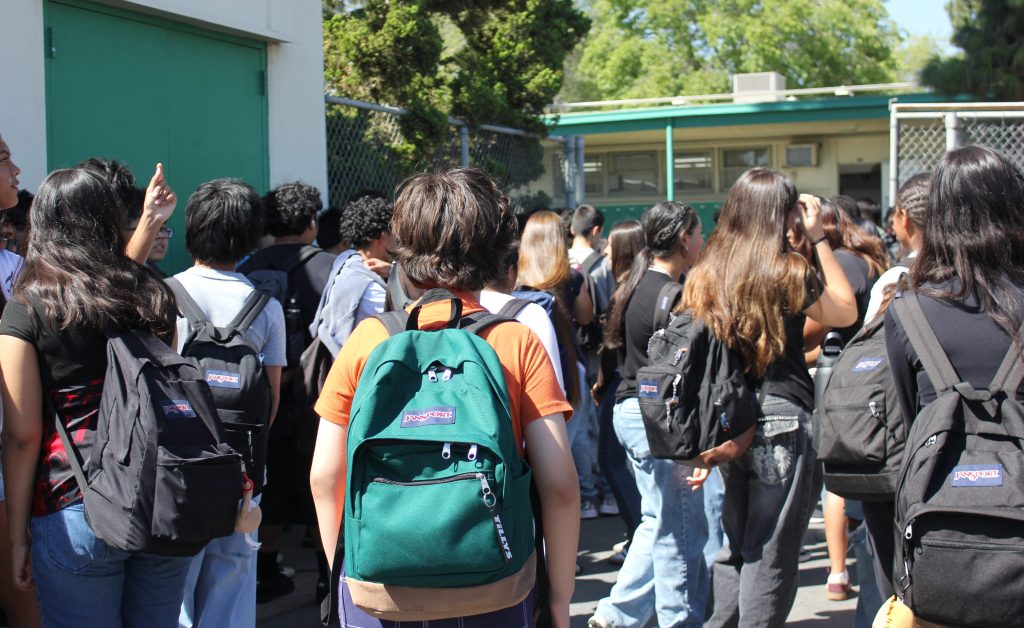
You sprint out of your third period to the nearest bathroom after being told by your teacher that you couldn’t go during class. There had already been a queue of people waiting for their turn. After weaving through the sea of backpacks and slow walkers in the halls, you finally reach the bathroom, only to find a huge line inside that would definitely make you late if you were to wait in it.
Granada Hills Charter High School (GHC) has a little over 4,700 students enrolled, making it the largest public high school in the entire San Fernando Valley, according to the Los Angeles Almanac. For context, the second largest high school in the San Fernando Valley listed is Downey High School, with a total enrollment of 4,163, over 500 students less than GHC.
This enrollment size doesn’t come without reason, though. As an independent public charter school authorized by Los Angeles Unified, GHC receives much of its state funding based on student attendance. Maintaining enrollment therefore affects the school’s financial stability and its ability to support a wide range of academic, athletic and extracurricular offerings. School leaders also view stable enrollment as evidence of continued community demand, an important consideration when GHC seeks to renew its charter with LAUSD.
Although from the perspective of a board member or superintendent, the rationale for the school’s size makes perfect sense, for many students and staff, it proves to be incredibly inconvenient, adding on to the continual hardships of working at and attending a high school.
Despite all staff at the school facing issues in handling the large student population, teachers in particular face extra challenges given that they are surrounded by and responsible for so many students. Teachers are often plagued with piles of work to grade, hundreds of faces to memorize, and large classes that can be stressful to manage. As noted in an article published by the National Education Association, educators feel that teaching is more difficult than ever, as it is impossible for teachers to meet their growing number of students’ individual needs, leading to many feeling overworked and exhausted. Unfortunately, this phenomenon is present at GHC too.
“As a teacher, it can be quite overwhelming to have classes where I don’t even have enough desks to accommodate all the students,” English teacher Rachael Phipps said. “It feels like added mental and psychological strain on top of the actual work concerns.”
Students arguably have it just as bad as teachers in terms of navigating through GHC’s large population. On the surface level, such a big school can make things like accessibility, physical space, and time management tough to maintain. Popular classes like ceramics and culinary often fill up quickly, causing some to miss out on fun course options. Waiting in line for both the cafeteria and carts can take up half of the lunch period on particularly busy days, making it so that simply getting a pizza can become a time consuming task. Even just looking for a shady spot to sit is absurdly difficult, with every corner of the school being full of other students.
“For the past four years, my friends and I have been sitting in front of the entrance to L building because there are no benches outside,” senior Maya Huber said.
On a deeper level, such a large population can also make it hard for students to feel truly connected at school. On one hand, GHC’s large population makes finding community very accessible. Students involved in activities such as athletic teams, marching band, or theater have smaller communities built into their schedules. For those who have not yet joined a team, club or program, endless opportunities exist for them to find their niche. Inadvertently though, so many opportunities at such a large school can make keeping track of things like tryouts or informational meetings overwhelming and disorientating, impacting one’s ability to feel a part of and connected to the school.
“I found out about the debate tryouts but it was a day after,” freshman Ariel Soriano said.
Even if you are able to follow everything happening at campus, just getting into certain teams, clubs, or programs can still be a challenge.
“The school is just so big and competitive because there’s a limited amount of spots,” sophomore Audrey Ku said.
Although the current population size of the school is necessary financially, there is no denying that it also sacrifices the well-being and connectivity of our students and staff. With there already being a waitlist of over 4,000 prospective students, and the number of freshmen admitted only seeming to grow each year, it’s time for heads of the school to take a step back, reflect, and ask themselves, ‘Is a big school really worth it?’
Big school, big problems: Why a large school isn’t better for us
You sprint out of your third period to the nearest bathroom after being told by your teacher that you couldn’t go during class. There had already been a queue of people waiting for their turn. After weaving through the sea of backpacks and slow walkers in the halls, you finally reach the bathroom, only to…
3–5 minutes