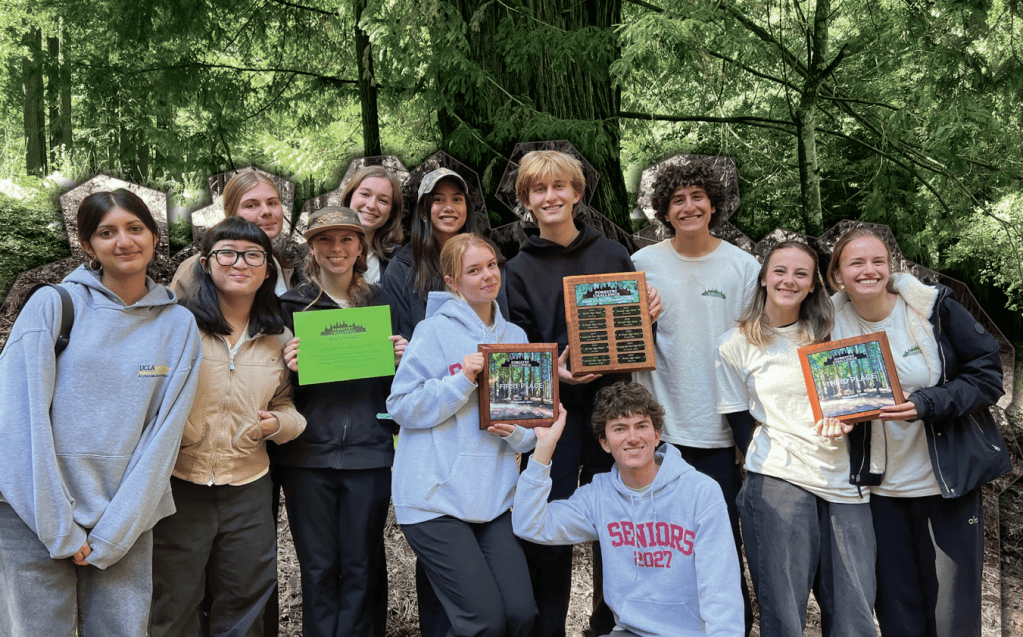
Protecting a forest can involve deciding which trees to remove. That relationship between harvesting and forest health was the focus of the Santa Cruz Forestry Challenge, where three Granada Hills Charter (GHC) teams competed October 7-10.
Led by science teacher Wendy Hagan, the school’s academic forestry team traveled to Redwood Glen in Loma Mar for four days of fieldwork, testing and presentations. This year’s focus examined commercial timber harvesting as a tool for improving forest resilience, using Pescadero Creek County Park’s Climate and Habitat Resiliency Plan as a case study.
Senior Rain Pompa explained that the competition combines fieldwork with a knowledge test.
“The basics is that we get together as a group and mimic a national forestry management project and basically learn different aspects about forestry,” Pompa said.
Students collect data in the field and use their findings to develop a group presentation. The competition also includes a team field test that requires students to identify and measure trees, interpret forest data, and make management decisions. Under competition rules, the field test accounts for 60% of the final score, while the presentation counts for 40%. Teams must also take a knowledge test covering topics such as local tree species, biology, and forest ecology and earn at least 200 points to qualify for the championship round in the Yosemite area.
The Santa Cruz curriculum includes tree identification, forest ecology, timber measurement, map interpretation, and the use of forestry tools such as Biltmore sticks, clinometers, compasses, diameter tapes, and angle gauges.
The management problem behind this year’s competition extends beyond the event. In 2020, the CZU Lightning Complex Fire burned more than 2,800 acres of Pescadero Creek County Park. San Mateo County also created a plan to restore the ecosystem and reduce fire fuels to protect the forests.
That case study connects the competition’s technical skills to a bigger question: How do forest managers balance timber production with habitat protection and long-term forest health.