By Sammy Gubbihal
With mile-long trigger warnings, dark romance is a literary subgenre that explores morally complex and often taboo romantic relationships featuring antiheroes or psychologically troubled male love interests. At first glance, the genre seems to give women power to choose the situations they explore, when in reality the characters themselves have little control.
The dark romance genre is not just littered with spooky men, but also terrifying tropes and themes. In H.D. Carlton’s “Haunting Adeline,” protagonist Adeline Reilly moves into her inherited estate and investigates the murder of her great-grandmother. During her time there, she attracts Zane Meadows, a stalker and vigilante hacker. Slowly, the line blurs between dark infatuation and absolute terror creating an obsessive game of cat and mouse.
“Haunting Adeline,” is one of many popular novels in the dark romance genre. Its portrayal of obsession raises a question: When readers find a fictional character appealing, does that mean they see his or her behavior as a standard for romance?
Some readers begin exploring these stories during their teenage years. A June 2026 paper surveying 300 adult female dark romance readers found that 16 was the most commonly reported starting age, accounting for 20% of respondents. Although that sample cannot represent all readers, it suggests some encounter the genre while still developing their expectations of relationships.
“I don’t often see [girls] reading dark romance in the real world but when I’m on social media, everyone reads it and tries to promote the genre,” Junior, Sarah Hilo, said. “I think it’s because the normalization of certain topics in the media that are extremely heavy make girls want to to feel as if though they relate to it when in reality they don’t.”
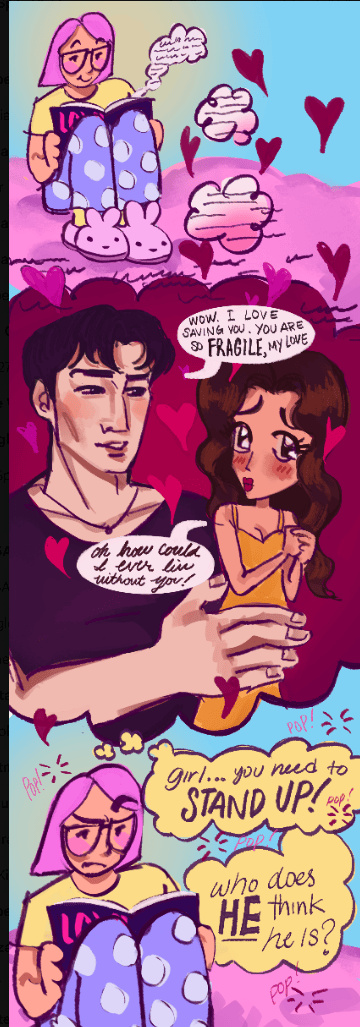
In books that dominate the genre, like Hooked, Butcher and Blackbird, and Corrupt, women have often been positioned as objects of male desire. Dark romance turns that dynamic on its head. The male protagonist becomes the object of fascination, with his appearance, power, and obsession scrutinized through the reader’s gaze. These dynamics can allow readers to explore ideas of romance through fiction before experiencing them in their own relationships.
“Dark romance often serves as a form of catharsis, allowing readers to engage with powerful and conflicting emotions in a controlled and safe environment,” researcher Magali Bigey says in The Conservation.
Part of dark romance’s appeal may be that it provides a fictional outlet to explore intense and forbidden fantasies far-removed from reality, specifically for women who already face the burden of having to look after so much that they now want to be taken care of.
“Dark romance explores the murky areas of love and desire, often characterised by fraught power dynamics and implicit or explicit violence between protagonists.”
Although the genre references themes of abuse and manipulation that many would look upon with concern, enjoying these stories does not automatically mean approving of those behaviors. Some readers can engage critically, recognizing that a compelling fictional relationship is not necessarily a healthy one.
Bigey discusses a 2024 study of high school girls that found examples of readers questioning the violence and domination in these stories. One student interviewed by Arnaud Genon, an educator at the INSPE in Strasbourg, suggested that portraying violent acts could help readers recognize their own absurdity. This illustrates one reader’s response, rather than proving every reader interprets this way.
A girl can enjoy a fictional power imbalance without endorsing inequality in her own life. The genre’s popularity does not necessarily mean that girls are becoming accustomed to toxic and abusive relationships; Instead, it may instead reveal the complicated ways desire, power, and autonomy intersect.
Still, the ability to separate fantasy from reality should not simply be assumed. There is a difference between exploring an unhealthy relationship in fiction and presenting control or manipulation as evidence of love. Readers can enjoy a story while questioning the behaviors it asks them to find romantic.
The spookiest monsters are left in the dark, and there is already enough darkness in the genre. Rather than leaving these stories unexamined, we should interact with them through more thoughtful analysis. Encouraging open discussion can help teenager readers explore complex emotions while thinking carefully about the difference between fictional fascination and the respect they deserve in real relationships.