By Juliana Johnson and Mia Mendez
During the first week of school, Granada Hills Charter (GHC) debuted a new video, detailing its rules and regulations for the upcoming 2023-2024 school year. The video, which teachers were required to show during homeroom, started off with the known student expectations, such as the cell phone policy and behavioral expectations. However, the video quickly turned south when they began discussing the school’s dress code.
GHC has always enforced a dress code policy, which they do in order to create a safe, productive, and disciplined school environment.
According to the student handbook, student dress cannot “cause actual distraction from or disturbance in any school activity or actually interfere with the participation of a student in any school activity.”
But within GHC’s new video, it wasn’t their dress code policies that caused uproar, but rather, their portrayal and explanation as to why these parameters are enforced.
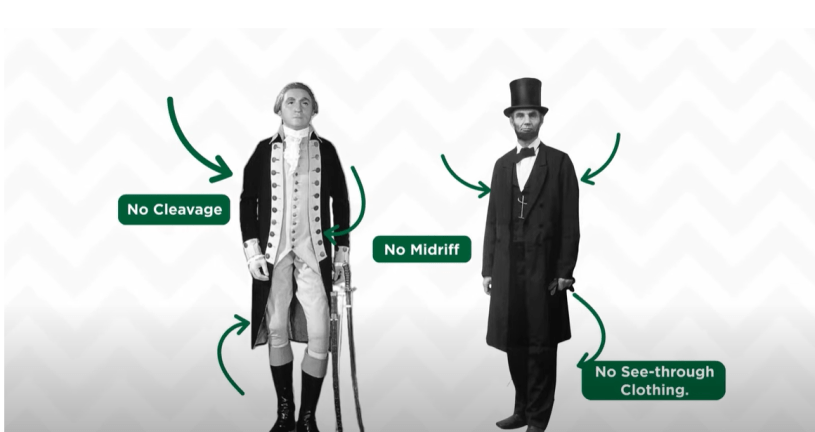
During the animated video, the narrator states, “No president ever made it by bearing a mid-drift or showing some leg,” equating that one of the main reasons these men rose to power was due to how conservatively they dressed.
The video’s portrayal of a male lineage of leaders, to represent why students shouldn’t “bare-midriff” or “show cleavage” sparked much uproar among many GHC students as these are two rules which mainly affect its female population.
Within the dress code segment of the video, three types of violations are described, including tight-fitting clothing, such as yoga pants, revealing clothing, and inappropriate messages on clothing. Out of these three examples, a female character is used to represent a violation of both clothing which is too tight, and too revealing, while male characters are only used for sections discussing inappropriate imagery.
Additionally, by using the metaphor of George Washington demanding respect by not showing cleavage, it reinstates the idea that women’s bodies are inherently inappropriate if they are ever on display, and that for this reason, they aren’t fit for positions of power. The two examples used, which were George Washington and Abraham Lincoln, not only came from time periods in which women didn’t have the right to vote, and couldn’t even wear pants, but were men who held extremely dated views of not only gender but how society should function as a whole.
While important for a well-rounded education and understanding of our nation, American presidential history is not the way we should be teaching young women and girls to be “respectable”.
Additionally, America has never had a female president, and is one of the few western countries which does not have a gender quota within their government. Therefore by using an American president, a job which women have been denied for centuries, to explain to teenage girls why they can or cannot wear certain items of clothing, is not only extremely disrespectful, but also propagates the idea that the female body is inherently “sexual” and an impeding factor on ones’ success.
Take a look for example at our current vice president, Kamala Harris. She is the first ever acting female vice president since the office’s establishment in 1789. Before Harris, there were no women within our country’s top 2 positions, and that definitely was not due to the fact that they all showed their cleavage.
“We are trying to shape a future community of young women who are leaders, and I didn’t see a problem with using one of the most well-known and respected leaders of all time, George Washington, to get that point across,” women’s history teacher Angela Heimbrock said.
Others such as fellow women’s history teacher Lara Willig felt that the comparison between young girls’ outfits and 18th century men was in poor taste.
“When I first saw the video, I was confused,” Willig said. “It’s not only that the examples were both men, but also the fact that they lived over 250 years ago. It’s problematic to put so much emphasis on clothing when fashion is ever-changing, and usually men and women aren’t looked at the same for what they wear.”
Dress code has become a hot topic of discussion in many classrooms across the country, with some students believing it is sexist towards female classmates, and others believing it isn’t strict enough.
When discussing Granada’s dress code with students, some agreed with sentiments that it marginalized the population.
“None of my guy friends or I have ever been dress-coded, and they wear things that they really shouldn’t,” junior Diego Laverde said.
Regarding the student’s feelings about the video, many were just as disturbed by GHC’s representation of the issue.
“If you’re going to talk about a woman’s body, you should have a woman in the video,” senior Jaime Coe said. “The video added to the idea that women’s bodies are objects and didn’t help us at all.”
Many young female students like Coe, have never agreed with the school’s dress code, calling it out for its sexist nature and marginalization of female bodies.
“I think it’s a harmful rule, the girls are treated as distractions,” Laverde said. “And using old white dudes to tell them why those rules are in place is really kind of gross.”
“The excuse for the dress code is always that sometimes what people wear is too ‘distracting,’ when in reality, what’s truly distracting is being punished in the middle of your school day and being made to change your clothes,” senior Emilio Nader said. “I see guys walking around wearing cuss words all over their clothes, or see-through tops and they’ve never gotten stopped.”
The most important takeaway from Granada’s video though, was how easily misogyny seeps into our lives, institutions, and in this case, our media without even batting an eye.
 The Plaid Press