By Megan Guerrero and Abigail Kim
Everyone experiences anxiety at some point in their lives; it’s natural. However, for some, it can be difficult to find ways to positively redirect anxiety in order to keep it from affecting their daily lives.
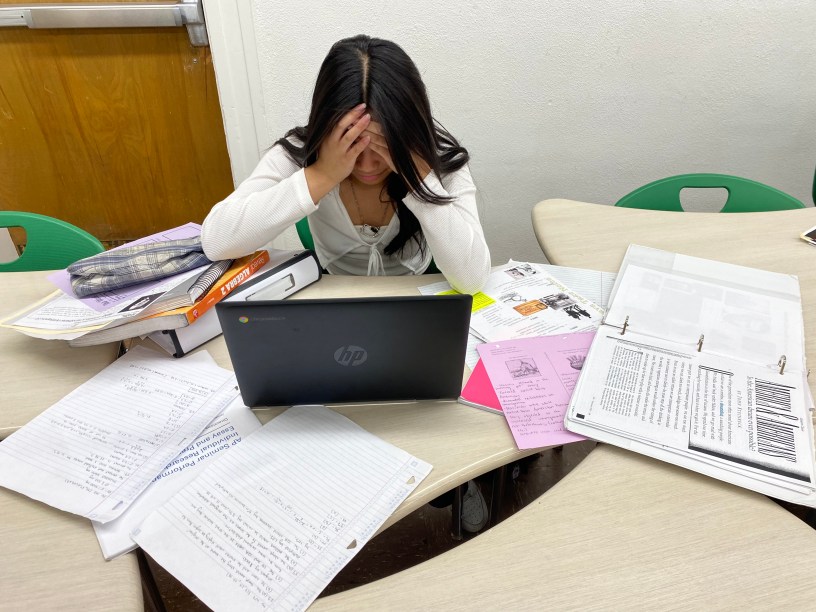
Many students can attest to the fact that school is a major cause of stress and anxiety. We live in a society that has set the standard that in order to be successful, students must excel in their academics as well as their extracurricular activities. However, by doing so, students begin to overwork themselves to the point of exhaustion, forgetting to take care of their mental well-being, which eventually leads to large amounts of stress and anxiety.
Although there can be a stigma to admitting feeling over-stressed or anxious, there are many ways to cope and balance the stress.
This might seem cliché, but instead of dealing with your anxiety on your own, it’s best to discuss with others about how you can work your way through your predicament. Rather than avoiding your anxiety, you must face it head-on especially while asking others around you for support and help. One of the best ways to cope with anxiety on campus is to visit the Wellness Center, a safe hub where students can express their thoughts and feelings to an adult who is there to listen and give you advice.
“When a student comes to the Wellness Center for anxiety, the question that we ask is ‘Where is this coming from?’” said Vicky Wen, one of the social workers in the Wellness Center. “‘What are you having anxiety about, and how can we deal with the triggers of it?’ When we talk about anxiety and how to solve it, we can’t just jump straight into solutions, because that trigger will always be there. It’ll continue on and that’s not really helping the future situation.”
The licensed social workers at the Wellness Center can help you to sift through all your thoughts and come to a final conclusion on the main causes of your anxiety. An additional measure of support is the steps the social workers offer that you can take in order to resolve your problems. It’s important to remember that everyone is different and has their own independent anxieties with a variety of origins. For this reason, the Wellness Center offers a variety of support methods, personalized for each individual.
“There are a lot of factors, and it’s different for every person,” Wen said. “If we were to generalize it based on the patterns that I see, a lot of people have school anxiety due to their grades. The fear of ‘I’m not going to do well in this class’ or ‘I didn’t study enough and now my test is going to be a low score,’ or because of peers. Students are often worried about something that happened with a friend, such as a rumor that is spreading. As a result, they become stressed in class because ‘so-and-so is there’ and ‘people are looking at me.’ Everybody is different, everyone has a trigger. We go from there.”
If you’re uncomfortable with going to the Wellness Center because you have trouble interacting with people, it’s okay to talk to the people that you are close with as well. It’s important to remember to choose people that you know are always going to be there for you and give you helpful advice and support. These figures can include your parents, siblings, friends, and teachers.
“It doesn’t have to be school staff, even a peer can help,” Wen said. “One of the best ways to solve a problem is to understand what it is. It’s that understanding of what is happening, what’s causing this issue, and what’s the correlation. A lot of the time, having a conversation about it helps. We also know that the person who is anxious has to speak up, and has to be willing to look for and accept that help. In situations like that what school staff can do is say, ‘Let’s solve this problem together. You’re not alone, let’s collaborate.’”
For some, it can be difficult to talk to others about their personal problems. Although it is always better to go to others for advice, there are some ways that you can deal with things partially on your own.
It’s best to find ways to redirect your anxiety into a positive outlet. According to the article 5 Ways to Cope With Anxiety, from KidsHealth, there are several ways students can combat anxiety on their own.
The first is by having a “growth mindset,” rather than a fixed one. By expanding your mind, one can learn to process their anxiety in a new and different direction that deviates from what they normally would.
“Brain science has shown that you can teach your brain new ways to respond,” according to KidsHealth. “People with a growth mindset know this. They know they can get better at just about everything — with effort and practice. That includes reducing anxiety.”
A more common way of combating anxiety is learning how to breathe. Proper breathing techniques can help you to relax and focus on all the thoughts that are running through your mind.
“Taking slow breaths can slow the release of stress hormones,” according to KidsHealth. “It can help your body and mind feel more at ease. As you guide your attention to your breath, you can pay less attention to anxious thoughts and feelings. Breathing like this can help you feel steady and less anxious.”
Aside from all the suggestions, remembering to take care of your body and mental health can be very helpful when it comes to managing anxiety. Yoga, meditation, exercising, listening to music, and even putting on a face mask can take your mind off all your stress, helping you maintain your anxiety in a positive way.
Learning to cope with your anxiety is best in the long run, whether it’s by talking with others, or practicing mindfulness and self-care. It’s important to note that you first must be willing to confront your anxiety and find ways that suit your needs, in order to see the benefits. By finding the right communities, support, and stress-relieving activities, you can learn to overcome your anxiety.
 The Plaid Press