By Kiara Amaya & Ashley Gilbert
In an era dominated by digital noise, the significance of journalism cannot be stressed enough. Student journalists, with their fresh perspectives and enthusiasm, serve as champions of diverse voices.
At its core, journalism serves as the guardian of truth in a time when information is easily manipulated, especially with the popularity of media platforms. Journalists play the role of truth seekers and tellers by separating fact from fiction and informing citizens without bias to promote democracy and free speech. These findings often significantly impact society and mold public opinion.
Through articles, broadcasts, investigative pieces, and more journalists provide citizens with the information they need to understand the state of their communities, societies, and governments. By exposing corruption and abuses of power, journalists become the voice of the people, ensuring that institutions are serving the public rather than overpowering them.
Young people, despite their potential, often struggle to have their voices heard and uplifted. Much of the political power that this country has is held by older Americans.
According to the Library of Congress, the average age of members of the House of Representatives was 58.4 years, whereas Senators had an average of 64.3 years. Even the President himself is the oldest in history at 79 years old. This demographic imbalance can lead young Americans to feel that they have no influence.
The connection that student journalists can build with their peers and communities can help validate young voices. It gives them a platform where their voices can be heard regarding important issues that may not be covered in larger-scale newspapers.
However, journalists face a multitude of issues in an evolving society. A lack of trust in the news represents a huge threat to modern journalism. With journalism’s digital transformation, there is much more room for media users to call out bias and create a fake news narrative. Additionally, unreliable news sources continue to promote this distrust.
Despite these challenges, journalism acts as a bridge that connects communities to valuable information. For student journalists specifically, press freedom allows them room to learn how to write fairly about real-world events that can often have complex attitudes. Protecting student press freedom allows students to grow as world citizens and journalists.
As they strive to achieve the same journalistic quality as professionals, student journalists simultaneously strengthen schools and democracy with the voices they uplift.
Students can express their views on social and political issues, highlight the injustices around them, and call for change. Through journalism, students can participate in public discussions and share their opinions on a broader stage.
This active participation helps student journalists gain confidence, assertiveness, and leadership skills. We learn how to convey our ideas effectively, stay informed, and stay on top of the latest trends. This amplification of voices helps students to become critical participants in the democratic process of schools and other communities.
Furthermore, student journalism teaches, fosters, and enhances critical thinking skills in students. Journalism necessitates the cultivation of analytical skills, including research, evaluation, and interpretation of data. Through this process, students learn how to filter the credibility of sources, discern fact from fiction, and scrutinize information for accuracy.
Critical thinking habits help students develop a deeper understanding of key issues, identify multiple perspectives, and strive for fair and unbiased conclusions. As a result, they obtain the ability to make informed decisions, question authority, and express their opinions based on facts and reasoning.
Moreover, student journalism can be instrumental in the growth of moral and ethical capability. Journalism gives students a platform to discuss, debate, and report on ethical and moral issues in their school or other communities.
The role of the press in society is to uncover the truth, hold people and institutions accountable for their actions, and ensure that the public is informed. This responsibility is premised on the moral and ethical values journalists are expected to uphold, including honesty, accuracy, fairness, and respect for human dignity.
Additionally, students learn how to handle sensitive information, balance competing interests, and adhere to ethical standards by participating in journalism. The practice teaches students to consider fair and humane practices in their reporting, morals in what stories they publish, how to be accountable for their reporting, and how to report news in an honest and unbiased manner. Just as it is for their professional counterparts, by producing quality journalism, students can become a positive force in their communities and help promote justice and equality through writing.
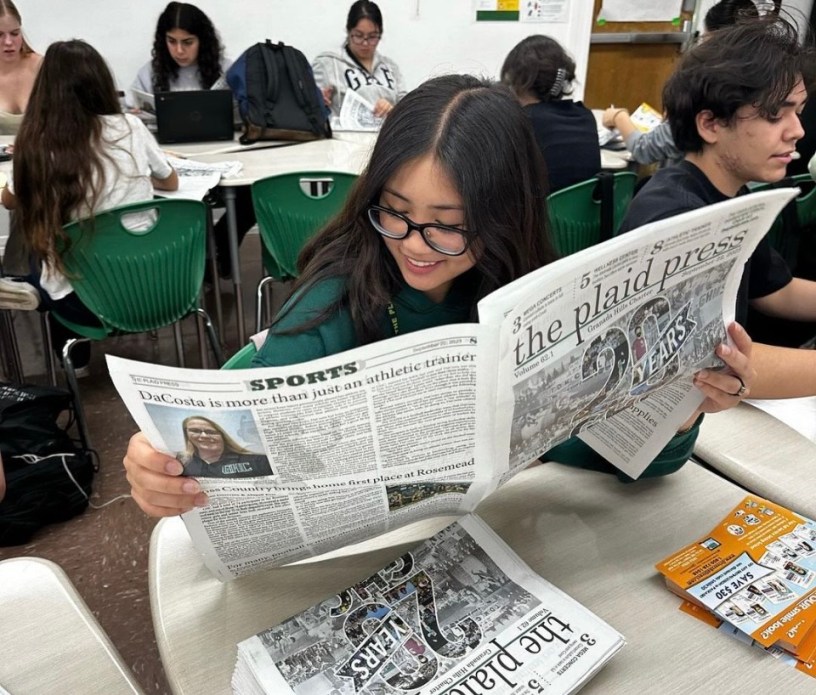
 The Plaid Press