By Dylan Huber
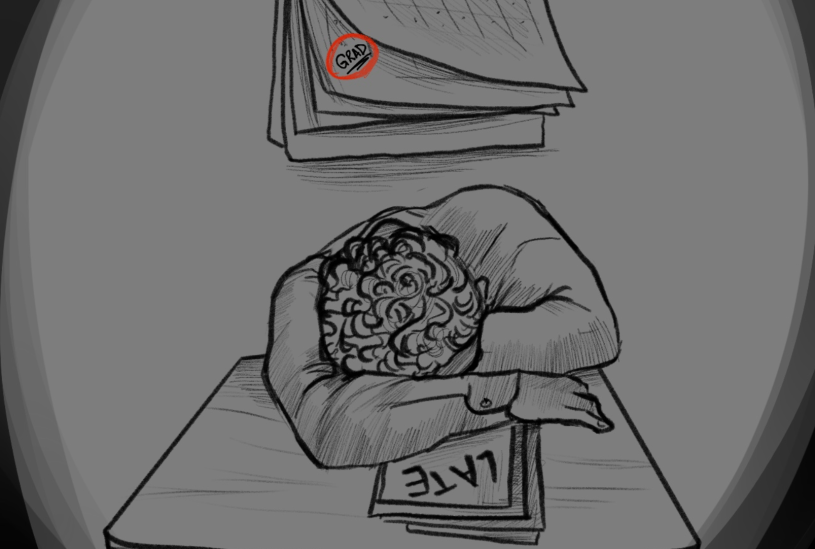
Senior year, despite all the annual hullabaloo over looming graduation, impending college apps, and headlong senior projects, is a year defined by profound apathy. This apathy is all-encompassing; assignments feel meaningless, studying seems worthless, acing tests lacks all drive it may have once had; one’s very motivation to exist within the boundaries of school has been all but eviscerated.
The full weight of the blame for this is, expectedly, placed on the person dealing with such alienating apathy: the student. They are advised, always, with the same myopic bromides as those that came long before them and those that will come long after. The shape of the advice varies, from describing their predicament as “lazy” or “unorganized,” but it always falls on a false understanding of what senioritis is: that it’s illogical. The parochial core of anti-senioritis platitudes is that the student is categorically irrational for feeling the way they do. The truth, I find, is quite the opposite.
From the beginning of high school to the end, a single rote conception dominates: that school is a “means to an end,” with the end being college. It’s a view that’s conditioned from the very beginning: students are repeatedly told the all-importance of doing each assignment, of always studying, and of acing every test; however, these things are not taken to be important for themselves: they are merely means. They are only important in that they are relevant to the end goal. This extends beyond even the sphere of academics, so often students only engage in clubs, volunteer work, or otherwise simply for the bolstering of their college-bound chances. Senior year, however, inescapably changes things.
During the first semester, college applications attain singular, eclipsing importance, itself being the final necessary tool to achieve the end. By the second semester, college admission is either on the cusp of being or has already been achieved, with graduation quickly on the way. And despite the constant fear-mongering harangued upon seniors over colleges rescinding admissions, such an occurrence is actually quite rare; in fact, “Only about 20 percent of colleges rescind at least one admission in a year,” according to the National Association for College Admission Counseling.
Bluntly, during senior year and especially by the time of second semester, the erstwhile unstoppable march of the “means to an end” will have reached a breaking point of relative unimportance.
The rational response is senioritis. The means no longer matter to the end goal, and as the means have never been anything more than means, the senior has no more reason to care; they never were conditioned to care in the first place.
Academic motivation was always illusory, in that it always presupposed an end. Remove the end, and the motivation disappears. This is why ‘advising’ a student out of senioritis is an absurd endeavor: the student has been taught a simple, systemically-backed equation, and senioritis is its logical, immutable conclusion.
Indeed, the student was always alienated from their work. Education maintained only a veneer of importance; a value that necessarily lies, to borrow terms from the philosopher Jean-Paul Sartre, purely in itself as a means. They were never truly connected to, or a part of, their work; value only existed outside of the students themselves, and it is thus that they were alienated. Freedom, passion, authenticity, creativity, all elements of conscious creation simply were never there. It is apathetic labor resulting in apathetic disillusionment.
And yet, education does have meaning. There is passion in learning, in studying, in freely and consciously enveloping oneself within the realm of knowledge. There is a possible world, a real future, wherein the endless rat race towards college, engulfed in competition and alienation, would finally end.
A world where colleges are not separated by inordinately different levels of educational quality and funding; a world where students would not be motivated to throw all passion and sincerity away for a “good school” under the belief that they need to get in one to survive, but instead have free access to a material, authentic education without the conditioned need for alienated drudgery.
It is a world that, frankly, is quite far away. It would take, after all, true structural change to achieve it; a realization, an actualized regaining of consciousness and understanding, that there is genuine meaning in passionate, authentic activity for itself.
Until then, however, the apathetic cry of senioritis will never cease, and mere means shall never take meaning.
 The Plaid Press