By Kai Bwor
Junior Jason Bowden and his journey through the realms of science and personal dedication is nothing short of inspiring. Bowden explored the complex field of immunotherapy in an internship at the City of the Hope last summer. Bowden continues to dive deep into cancer research during the school year but also manages to balance it with a rigorous class schedule, sports, and his hobbies. Through this, he showcases his curiosity and undeniable perseverance.
Bowden’s journey into science began with his fascination for immunotherapy. This cutting-edge treatment enables the immune system to fight cancer, which led him to explore its potential to treat acute myeloid leukemia (AML), a cancer of the myeloid-lineage blood cells of the bone marrow.
During the summer, Bowden participated in the Robert’s Summer Academy at the City of Hope, one of the largest and most advanced cancer research and treatment organizations in the United States. During this program, he learned about scientific research, leading him to dedicate three to four days a week during the summer to studying this field through online courses over Zoom. Through his determination, he learned about an antibody that binds to cancer cells and receptors on T-cells, a type of white blood cell, causing cancer cell death and prompting the cancer cells to reveal more markers, making them easier targets for the immune cells.
As one of the few high school interns, Bowden worked closely with the lab staff, learning the ropes of research and collaboration.
Bowden’s work at the City of Hope also involved a fascinating experiment with a humanized mouse lineage, which are mice with human immune system components. He isolated bone marrow from the humanized mouse to investigate which immune system components were human. The second part of the experiment involved creating and transducing a retrovirus with the blood cells to see if it caused cancer—and it did.
Bowden’s project concluded that the mice can receive humanized cancer and have the correct immune system components, making it ideal for testing his laboratory’s new bispecific antibody treatment.
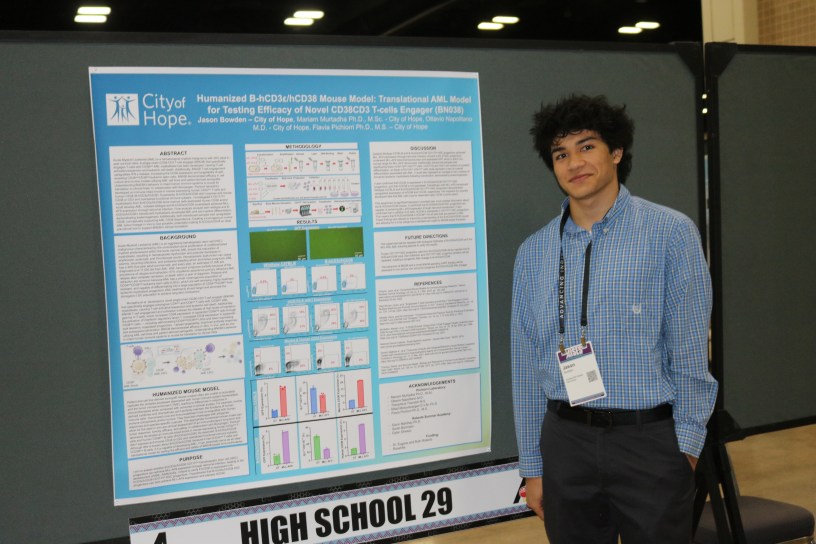
He documented his findings in a research paper and poster. He then traveled to the American Indian Science and Engineering Society (AISES) National Conference in San Antonio, Texas, to present his findings, showcasing his work to a wider audience.
Outside of traveling to conferences, Bowden’s regular commute to the lab this summer was nothing short of an adventure. With a one-hour bus ride followed by an hour-long train journey to Monrovia, he transformed travel time into something productive. Although one would expect him to be reading medical journals, Bowden often also indulged in hobbies such as embroidery.
“I think it’s important to take time to relax and decompress after a long day of work to maintain a good balance,” Bowden said. “I try to fit in as much time for creativity and self-expression as I can.”
As a member of the Granada Hill Charter’s (GHC) water polo team, he dedicates his time before and after school to practices and competitions, earning recognition as the second leading scorer on the team last year. He balances his academic and social life by doing as much homework as he can in class. Although the balance is difficult to maintain, he focuses on allowing himself enough rest to stay on top of his busy schedule, as well as nurturing his personal interests.
“Sometimes you have to put your head down and get it done,” Bowden said. “If I want to go out or hang out with my friends, I have to lock in.”
Despite his busy schedule, Bowden continues to thrive in all areas, proving that with determination and effective time management, balancing academics, extracurriculars, and personal interests is achievable.
 The Plaid Press