By Cooper Hofmann
Pixar’s “Ratatouille” makes a very bold, debatable statement. It proudly proclaims that “anyone can cook.” I’ve had spaghetti with meat sauce made from unseasoned turkey, I’ve eaten steak that was somehow burnt on the outside, and raw on the inside. Everyone can cook, but not everyone can do it well.
It’s the same when it comes to sports. I’ve seen newer wrestlers sweep someone’s legs, and they get right back up. When someone truly exceptional swept my legs, I fell flat on my back and couldn’t breathe for a minute and a half.
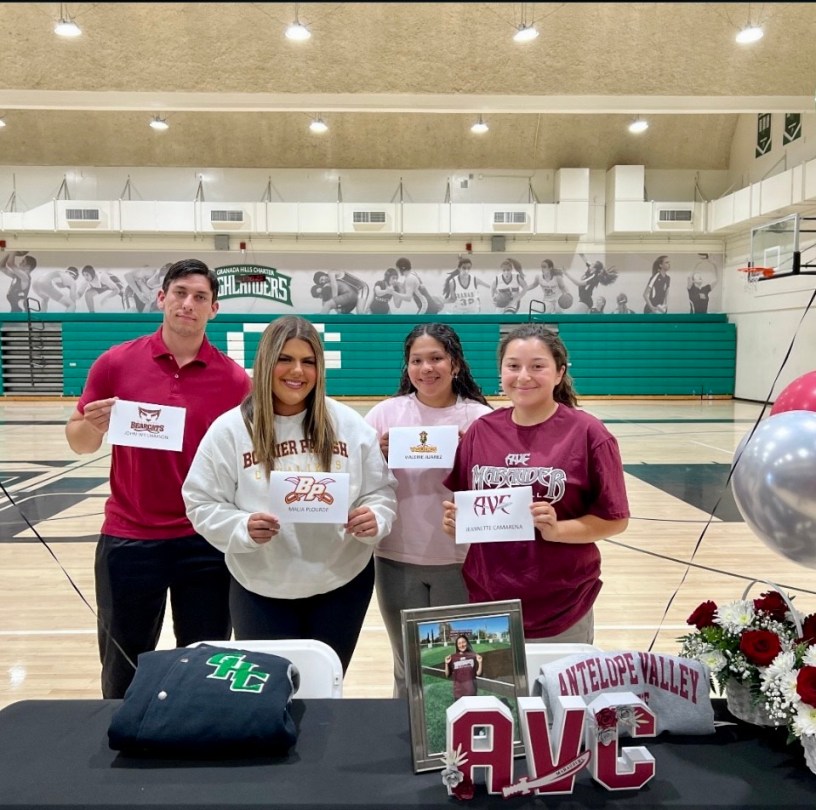
That is to say, there’s a distinct difference between the average athlete and the kind of people your coach tells you to learn from. Those people are scholarship athletes so good that a college is asking them to attend, which is remarkable considering how tough it is to get a college to pay attention to your application for even a split second. The question is, what does it take to play college sports, and reach greater heights as an athlete?
“I’ve played softball for around ten years,” varsity softball player and Lehigh University commit Addison Moorman said. “I hit the weight room five times weekly, and I have individual lessons as well.”
It takes a decent amount of time and dedication—both in and out of the school team—to get to Moorman’s level where a university like Lehigh (ranked 46th in the nation) will give you a full-ride scholarship.
If the idea of spending over half your life playing a single sport is a little daunting, there are more ways to receive a scholarship. Surprisingly enough, not everyone is thinking about college admissions at eight years old.
Little do they know that admissions prep works like dog years, and you should really be building your resume somewhere between three or four years before you’re born. Time is closely related to your growth in a skill, but other committed athletes say it isn’t about the total time spent. Rather, how you spend that time and improve your skills.
“I think anyone can get a scholarship offer if they’re putting their all into the sport,” varsity baseball player and UC Irvine commit Alexander Schmidt said. “My parents always taught me to try hard in whatever I do, and I try to put that into my sports life. If you’re doing something like going to the gym two or three times a week after practice, that’s going to set you ahead of others, and colleges notice that.”
I initially said that you need to be planning your bright career in athletics as young as possible, when really, it’s the quality of training, rather than the time spent training. Getting an offer is about going above and beyond, standing out in a sea of other athletes. The aforementioned “above and beyond” includes extra workouts, because they add up, and colleges notice when you outperform others as a result.
The thing that I noticed with the amazing committed athletes I interviewed, was that they didn’t show doubt in their skills. That doesn’t mean that they didn’t see any flaws in their abilities, but they are confident in what they could do. I think that to be skilled at something, you have to trick yourself a little bit, enough to where you live up to your own hype. If you can do that, you can do anything, even get a scholarship offer.
“I would say that confidence comes with success, but also the support of those around you. A positive mindset is what leads to success which then builds confidence,” Moorman said.
Gusteau says “anyone can cook, but only the fearless can be great,” and though I doubt a fearless rat could beat me in just about any sport, his point still stands. The perseverance required to receive an accolade as big as a college offer is difficult, that’s assured. But that mindsets sets back so many. It isn’t just based on natural talent, and you don’t have to be born an athlete to get a scholarship. It’s about hard work, dedication, and persistence. So maybe, the thing that gets colleges calling is being confident in yourself, and taking the risks that you’re not so sure of.
 The Plaid Press