By Elizabetta Orsi
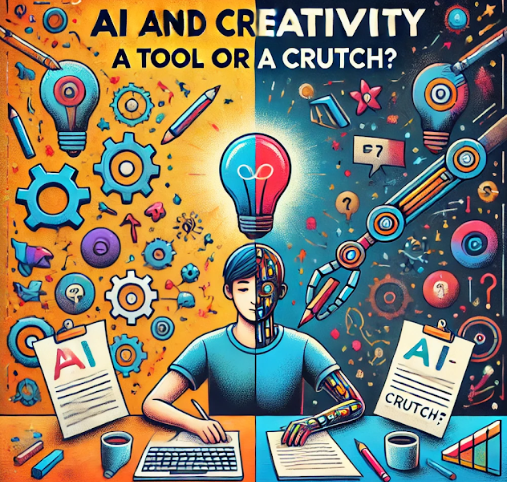
AI tools such as ChatGPT are becoming the go-to assistants for students who struggle to meet deadlines or brainstorm ideas. These tools are powerful, fast, and undeniably convenient. But beneath the convenience lies a significant cost: the deterioration of student creativity. While AI can help generate answers and draft essays, using it as a crutch for school assignments can dull the very skills that education is meant to enhance.
Creativity isn’t simply the act of producing a piece of art or writing, but a cognitive skill that allows students to problem solve, think independently, and form original ideas. Thus when AI generates responses, students often completely bypass the mental effort needed to develop these skills. Instead of wrestling with the nuances of an argument, or the challenge of an open-ended question, students simply ask AI for answers, forfeiting the creative process.
Imagine an English class for example, where students are asked to write an essay conveying their own interpretation of a piece of fiction. If the student runs to AI for a thesis, analysis, and overall argument development, they are essentially outsourcing the most integral part of the assignment. The more this happens, the harder it becomes to develop unique thoughts independently for any situation, not just ones inside the classroom.
Creativity often emerges through struggle. Whether it’s brainstorming ideas for a science project or revising an essay draft, the process of trial, error, and revision is essential for growth. AI makes this process obsolete, offering ready-made solutions and removing the struggle that fuels learning.
This reliance on AI is like skipping a workout but expecting to get stronger. Without engaging in the mental exercise of problem-solving, students miss out on developing resilience, critical thinking, and creativity, skills that they will need long after they leave school.
AI-generated work also tends to follow patterns. Although AI can write an essay that makes very literal observations, or generate a reasonable answer to a math problem, it lacks the personal insight and originality that makes true creative work stand out. As more students rely on AI, their work risks becoming uniform and begins to lack individual voices and perspectives.
Because of this, AI-generated assignments are often easy for teachers to recognize, not simply because of the use of AI detectors but because the responses lack this sense of personality and depth. This not only affects grades but also denies students the opportunity to express themselves through their work. Still, this doesn’t necessarily mean that AI is evil or something to avoid. AI is a tool of the future, and learning how to use it wisely is essential. Instead of replacing your thought processes, AI can even play a role in enhancing them. Outside of academic settings, AI can be used to brainstorm or overcome creative blocks. In these cases, it’s essential to remember that the role of AI is to act as a collaborator, not a replacement for your thoughts. Take the time to develop those ideas independently and personalize any outputs to reflect your unique voice and perspective, ensuring that we create a world where technology and creativity can coexist.
 The Plaid Press