By Ezra Caber
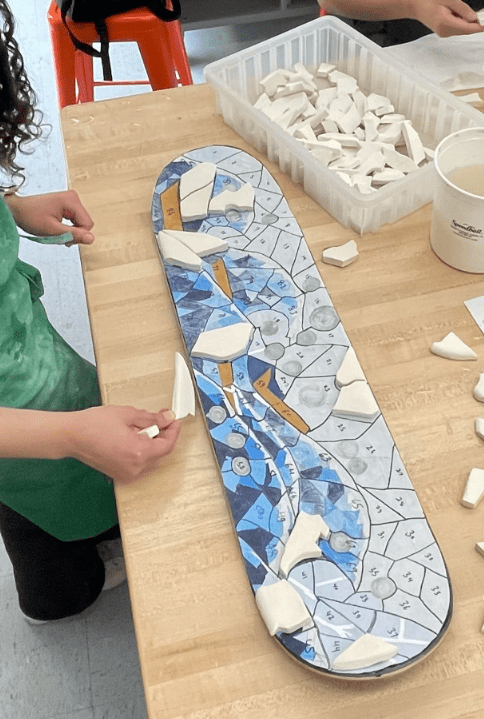
When we think of the word “ceramics”, people typically think of bowls or mugs and historically, it’s been pots. However, many artists today get a unique take on creating things other than what’s made traditionally. For example, Julie Neumann, VAPA Department Chair and ceramics teacher, has taught her advanced ceramics class how to create ceramic skateboards.
Although these skateboards cannot actually be ridden, students can create something where they are free to express themselves as artists and carry something important from high school. The way skateboarding culture is about self-expression is what Neumann wants to bring into ceramics. Her students are able to assert and express personal art style when creating their skateboard, similar to how skateboarding culture is surrounded by individuality.
The process for creating ceramic skateboards is more complicated compared to creating classic ceramic pieces like mugs and vases. From brainstorming to the last glaze firing, the process is extensive and will take at least a month, according to Neumann.
Students start off with brainstorming a design on a small scale. During this stage, students often get inspiration from different artists, their own hobbies, or their cultures. When creating their first sketch, the student-artists use color in order to think ahead on what colored glazes they’re going to use later on in the process.
Then students transfer that design to a paper template the size of a real skateboard, which acts as their blueprint. In creating the actual skateboard, a wooden deck is covered in clay. Students then transfer their design again from the blueprint to the clay covered deck. Students then cut out the designs from the clay covered deck, making them tiles, refining and smoothing the tiles. These tiles are then fired for the first time in the kiln. After cooling, they’re pieced back together like a puzzle. Students glaze these tiles and fire them a second time.
Once the tiles are glazed and fired, the students will adhere them to the wooden deck using mastic. After letting the tiles dry, the students grout the gaps of all tiles, making this the last step in creating a ceramic skateboard.
Although the process is very organized, it does come with challenges. When a clay piece is fired, the piece will shrink about 11 percent . One of the difficulties in creating these is estimating and working out the shrinkage. To fix this, students use the shrinkage to map out the grout lines.
Neumann became inspired to teach creating ceramic skateboards by a peer art teacher who teaches in Las Vegas. She taught painting skateboards as well as the culture of skateboarding in general.
Neumann saw this as a way to connect art with local culture for her own students since skateboarding originated in California.
“It’s a very long process but getting your emotions out is good and it’s a fun way to express yourself through art, along with seeing your hard work pay off,” senior Avi Juarez said.
In all of her lessons, Neumann emphasized that self expression is an important part of ceramics and art in general. When students are able to enter advanced ceramics, she likes to see people explore new things and further express themselves with ceramics.
“The most rewarding thing about teaching ceramics is being the class that most students enjoy coming to,” Neumann said. “As they work with clay, I see them more relaxed and smiling. Although most students haven’t worked with clay, many who go into ceramics thrive even with no prior experience. It does a lot for their sense of accomplishment and it increases their self-confidence.”
 The Plaid Press