By Nancy Azzam
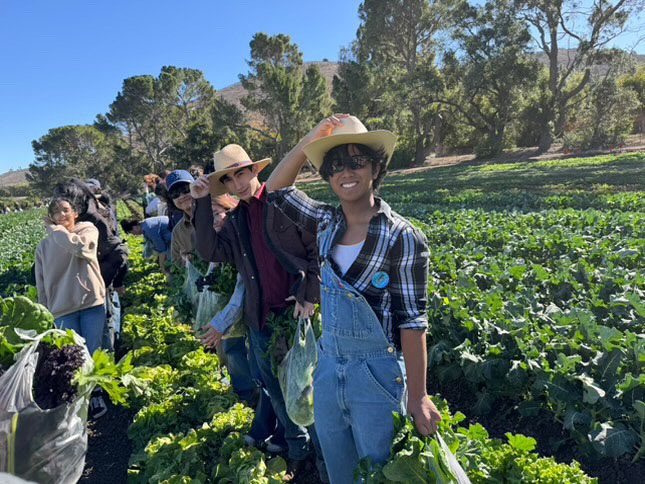
Thursday, January 23 marked the first time that AP Environmental Science (APES) classes took part in an interactive field trip at Underwood Family Farms in Moorpark, California.
Although science teacher Wendy Hagan has previously taken her Envirothon students on this trip before, this was the first time APES students were able to participate, allowing them to get hands-on experience that correlates directly with their curriculum. Currently, our APES classes are focusing their learning on sustainable farming practices and strategies to ensure a well functioning, efficient, and flourishing farm of their own. This field trip enables them to open their eyes to what it takes to produce and has connections to varying aspects of their understanding of environmental science.
“We heard from an expert that gave our students further insight on different farming techniques,” Hagan said. “They pointed out the difference between sustainable farming versus organic or commercial techniques that benefitted my students’ through real-life application. The field trip emphasized different factors that influence the farming industry such as varying legislation set in place for crops and livestock as well as the best seasons for production.”
Students were greeted by a farmer who explained how the farm runs, the crops that they produce, and how they are able to impact the community. The students then took part in an informative tour of the crop fields and were able to pick up a variety of fruits and vegetables themselves. This was followed by an animal show featuring Underwood Farm’s goats, rabbits, and pigs. Toward the end of their farm experience, students were able to explore the farm for themselves and were even given the opportunity to feed the animals hands on.
“This field trip helped my understanding of the class because we got to explore a farm and see first hand sustainable farming and the strategies farmers use, which is one of the things we are learning about in our class,” senior Destiny Arroyo said. “What I enjoyed the most was being able to feed the animals, specifically the pig, and being able to pick our own vegetables.”
Their experiences allowed them to learn more about sustainability and see what they have learned in the classroom being applied in real life. Not only this, but they were able to witness that sustainability being encouraged locally.
This field trip linked to the students’ most recent project in the class, creating a sustainable farm of their own. Prior to the trip, the students were tasked with researching and bringing to life a farm plan meeting the criteria of their prompts given to them. The projects consisted of putting together a plan that takes into account several sustainability practices for land and water use, waste management, energy conservation, and more.
“Ideas for their farm’s location, soil type, access to water, and how to incorporate communities all came up during the field trip and their understanding of these aspects really shined through their projects,” Hagan said. “Students were able to develop strong social connections and economic plans for those involved in their farm.”
The carefully researched projects were compiled onto decorated tri-folds and presented in Highlander Hall to be judged by Hagan’s IB Year 2 Environmental Science class on Wednesday, January 29. Students were able to showcase their understanding of sustainable agriculture and their abilities to think critically.
 The Plaid Press