By Ashley Gilbert
The United States government made a significant move in its ongoing struggle with foreign technology influence by issuing a nationwide ban on TikTok. This decision was rooted in the Protecting Americans from Foreign Adversary Controlled Applications Act, passed by Congress and signed into law. The ban ignited a multitude of discussions about digital rights, national security, and the future of social media in the U.S.
Though some may argue that the TikTok ban is protecting us, it can also be seen as the government overreaching unnecessary boundaries, stifling creativity.
TikTok, a platform that has captivated millions through its short-form video content, became the focus of scrutiny due to its ownership by ByteDance, a Chinese company. Concerns regarding data privacy, foreign influence, and potential surveillance heightened over the years, leading to calls for government intervention.
The Act defined “foreign adversary controlled applications” to include TikTok, along with any related applications or services operated by ByteDance. Under Section 2(a), the Act prohibits entities from distributing, maintaining, or updating these applications in the U.S. As noted in Donald Trump’s order, “By the authority vested in me as President by the Constitution and the laws of the United States of America, it is hereby ordered to take action on behalf of the United States to enforce the Act.” This highlighted the administration’s view on the urgency of addressing what it deemed a national security threat.
The question of the ban being a worthwhile use of the government’s time can further surface as it does not seem as a serious enough threat to our country. Therefore, is the ban really that big of a threat that justifies the drastic measures it is obtaining? It overall seems more symbolic than practical, especially seeing that other apps the U.S. government permits collect data as well, is this really about security or control?
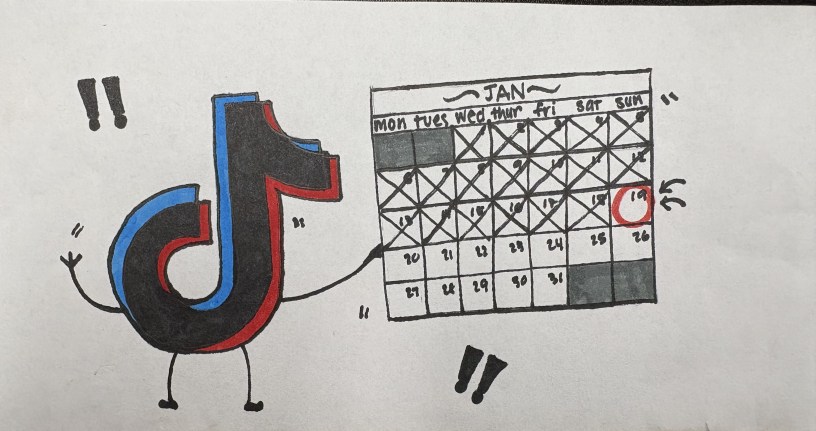
The repercussions of the TikTok ban were immediate and far-reaching. As of January 19, 2025, users found themselves unable to access a platform that had become an integral part of social lives, marketing strategies, and even protest movements. The app contained a message stating, “A law banning TikTok has been enacted in the U.S. Unfortunately, that means you can’t use TikTok for now. We are fortunate that President Trump has indicated that he will work with us on a solution to reinstate TikTok once he takes office.” As a result of this, content creators and businesses, many of whom banked their careers on TikTok, faced an uncertain future. Businesses that relied on the platform for advertising had to quickly adapt their strategies, creating chaos in the digital marketing landscape.
The ban appears less as a measure of national security and more as an exercise in governmental control, raising concerns about the erosion of personal freedoms and the influence of state power in shaping digital spaces. While advocates of the ban argue that it is necessary to protect user data from foreign entities, critics point out that such actions may be driven by a desire to regulate information and inhibit platforms that facilitate free expression, creativity, and dissent. Although supporters of the ban argued it was a necessary step to protect Americans from Chinese government influence, critics insisted the move interfered with personal freedoms and harmed the digital economy.
“I have the unique constitutional responsibility for the national security of the United States,” Trump emphasized in an executive order, “to fulfill those responsibilities, I intend to consult with my advisors on the national security concerns posed by TikTok.”
Reactions to the ban divided the public. Advocacy groups such as the Knight First Amendment Institute at Columbia University, Fress Pass, and PEN America urged the Supreme Court to strike down the ban, arguing it set a dangerous precedent for censorship and freedom of expression. They expressed fears that a government-controlled digital environment could limit access to diverse viewpoints and creative content.
Seeing that the app promotes individual’s free speech, allowing them to connect to audiences, the ban of the app is further limiting communitie’s platforms of free speech.
However, many parents and conservative voices supported the ban, lauding it as a protective measure against what they saw as harmful, addictive content—especially for children. Whatever side one stood on, the consensus was that the ban represented a significant shift in how governments can regulate digital platforms. The ban was not merely a singular governmental action; it was a significant moment in the ongoing battle between technology, privacy, and national security. The administration sought to navigate these challenges while acknowledging the unique and influential role of social media in modern life.
While the decision to ban TikTok aimed to mitigate national security risks, it simultaneously sparked important conversations about privacy, economic impact, and digital freedom. The fallout from this ban is likely to have a lasting impact through policies and public discourse for years to come, leaving us to consider the balance between national security interests and the rights of millions of users who interact within these digital platforms. The landscape of social media and technology is ever-evolving, influenced by legislative decisions and the interconnectedness of our global community. We must engage, advocate, and ensure our voices are heard as we navigate these changes together.
 The Plaid Press