By June Peers
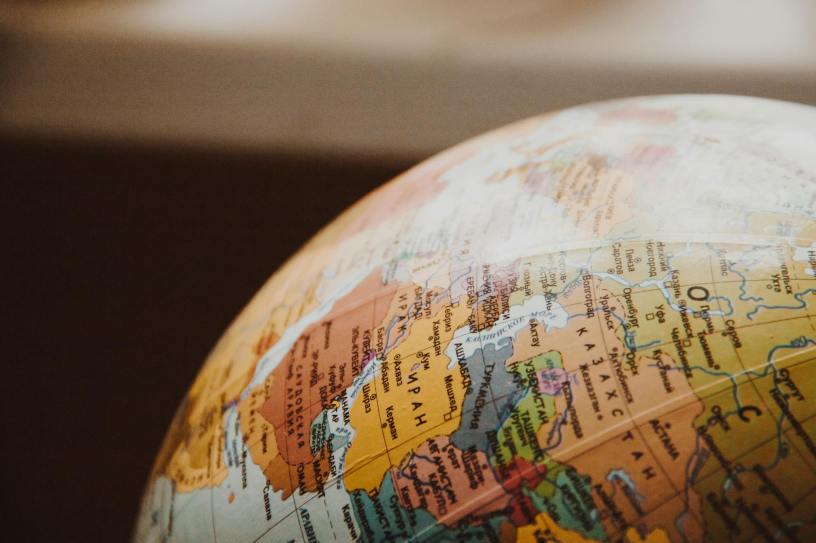
At Granada Hills Charter (GHC), the Social Science Department requires students to take an array of courses, including World History, U.S. History, Economics, and Government. The department recently added courses that view history from specific lenses, including those of immigrants, women, and African Americans. This wide array of courses strengthens students’ critical thinking skills and fosters an understanding that history can have multiple interpretations. However, I believe our Social Science Department is lacking in one area: geography.
It is evident from the murmurs of confusion in classroom conversations that youth’s geographical proficiency is at an all-time low. Murmurs of confusion revolve around the classroom. “Russia is in both Europe and Asia?” “Texas is near Mexico?” “Japan is an island?”
According to the Grosvenor Center for Geographic Education, in 2020-21, only ten states required a combined geography and social studies course, only three of which required a standalone geography course. Predictably, the declining popularity of geography education is affecting students’ scores on geography standardized tests. The 2018 National Assessment of Educational Progress reported that nearly three-fourths of eight-graders scored below proficient in geography.
This lack of geographical knowledge has real-world consequences. In an increasingly globalized society, students need to understand geography to grasp international relations, trade, climate change, etc. Without a foundational knowledge of geography, young people will struggle to understand global conflicts and even domestic issues such as immigration. They need geography to engage with current events and make informed decisions in the future.
Though the College Board introduced AP Human Geography in 2000, this course is neither sufficient nor comparable to geography itself. Any student who has taken AP Human Geography can attest that the course material barely covers cartography and physical geographical areas. Rather, it focuses more on migration patterns, cultural processes, and industrialization.
The American education system desperately needs to require a stand-alone geography course as a graduation requirement, not just an elective. They should also instate an AP Geography course. The course material would cover basic topics, including geology, water systems, climate, and map reading.
Geography courses would certainly improve the U.S.’s poor performance on standardized tests. The American education system should direct more of its efforts toward improving its performance on the Program for International Student Assessment (PISA), a global standardized test distributed among 15-year-olds. Under its “global competence” framework, students are tested on their understanding of cultural interactions and international affairs. To excel on this assessment, students need a strong foundation of geographical knowledge. An exemplary country with a comprehensive geography curriculum that America can look toward is Singapore. Singapore is ranked #1 on the PISA. The U.S. is ranked #18.
We should structure 11th grade history similar to that of 12th grade. This would entail one semester of U.S. History and another semester of geography. For students opting for AP History, the College Board would have to condense the material of AP U.S. History to accommodate for this shift.
Some may argue that U.S. History should not have to sacrifice its material for the inclusion of geography. However, I would argue that U.S. History is disproportionately represented in history education. Across elementary schools and middle schools, U.S. history is presented in one way or another. With years of learning under students’ belt, many are already familiar with American history, ranging from the role of Native Americans to the American Revolution. Thus, a mandatory year-long course of purely U.S. history in high school feels redundant. A semester of U.S. history and another of geography would be a more productive way of exposing to a variety of historical disciplines. In other words, why teach more of the same when there’s an obvious gap in geographical understanding?
Geography would have a profound impact on advancing students’ geographical skills while allowing them to critically analyze the globe. We have seen in the past that the College Board is capable of reform with the creation of AP Human Geography, and for the 2024-25 school year, AP African American Studies. By taking this initiative, high schools will produce informed and culturally aware graduates.
 The Plaid Press