By Samantha Posa
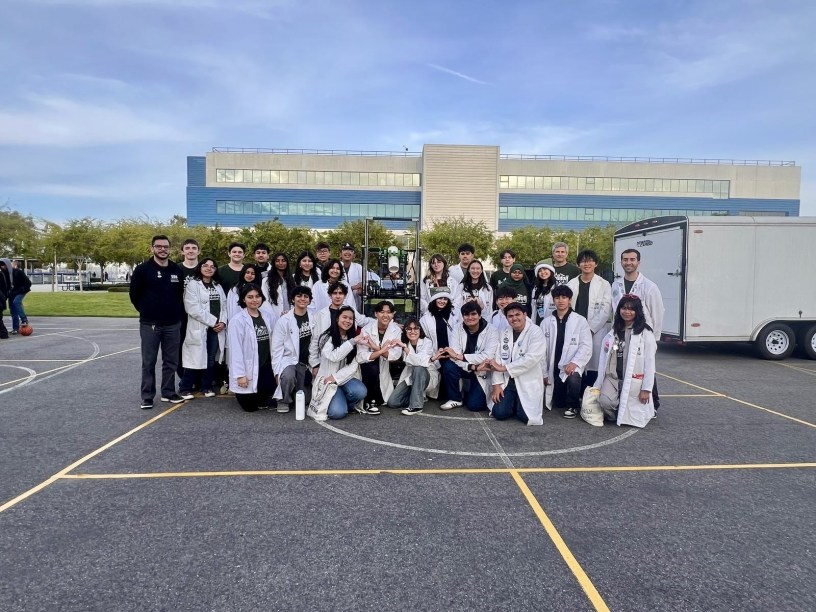
From April 3 to 4, Granada Hills Charter (GHC)’s Robodox FRC team culminated their competition season at the Aerospace Valley Regional FIRST Robotics Competition. The team gave a strong performance, reaching the semifinals.
The tournament served as the second qualifier competition for the FRC World Championship, which takes place in Houston, Texas April 16-19. Spanning over the course of three days, robotics teams from all different robotics organizations had their robots battle it out on the playing field in games of Reefscape. Robots went around the arenas harvesting balls titled “algae” and PVC pipes labeled as “coral” to rack up points.
Prior to the finale of the FRC’s competitive season, the VEX subdivision also competed at the VEX States Championship from March 14 to 16. Winning against many high ranking teams in Southern California, the state championships served as a successful end to VEX’s competition season.
The success of this year’s competition season is the result of the team’s extensive work ethic and collaboration. In the weeks leading up to the regional qualifiers, Robodox remained hard at work manufacturing all the parts needed to make a new robot for this year’s season, staying late after school and coming in on weekends to do so.
“Most of our team members are staying till 6:00 p.m. four days a week to keep up progress with our rigorous build season schedule,” senior and President Beepashna Bista said. “It definitely has drawn our members closer together and fostered a sense of unity on the team when we see FRC and VEX members dedicating so much effort into a common goal.”
When not competing in tournaments or building robots, there are many other aspects of engineering the team covers. Members organize events, participate in community outreach, and manage finances to ensure the success of the team beyond the robot’s performance on the playing field.
“One thing we’ve emphasized more this year is the different FRC technical divisions of our team working in parallel,” Bista said. “We tried implementing this process in previous years, but I feel that those cumulative efforts are more apparent this season. Our VEX members have also been more efficient with managing their time and resources this season which allowed for more iterations of our robot and improvement in our competition performance.”
Despite being such a large team, it is important to acknowledge the individual efforts put in to fully flesh out the robot’s development. The small victories and achievements celebrated after every session is what builds up the robot from scratch.
“Every single member is crucial to the success of our team,” junior and Logistics Executive Orielle Garcia said. “Most of our members have played a key role in designing a specific subsystem, making parts, wiring up our robot, and making a code for the robot to move on the field.”
 The Plaid Press