By Kai Bwor
Starting a new club is a great way to build a community around a shared passion. But if you have tried to get one off the ground, you know how overwhelming the process can feel, especially when you’re racing all over campus to find a teacher to be your advisor.
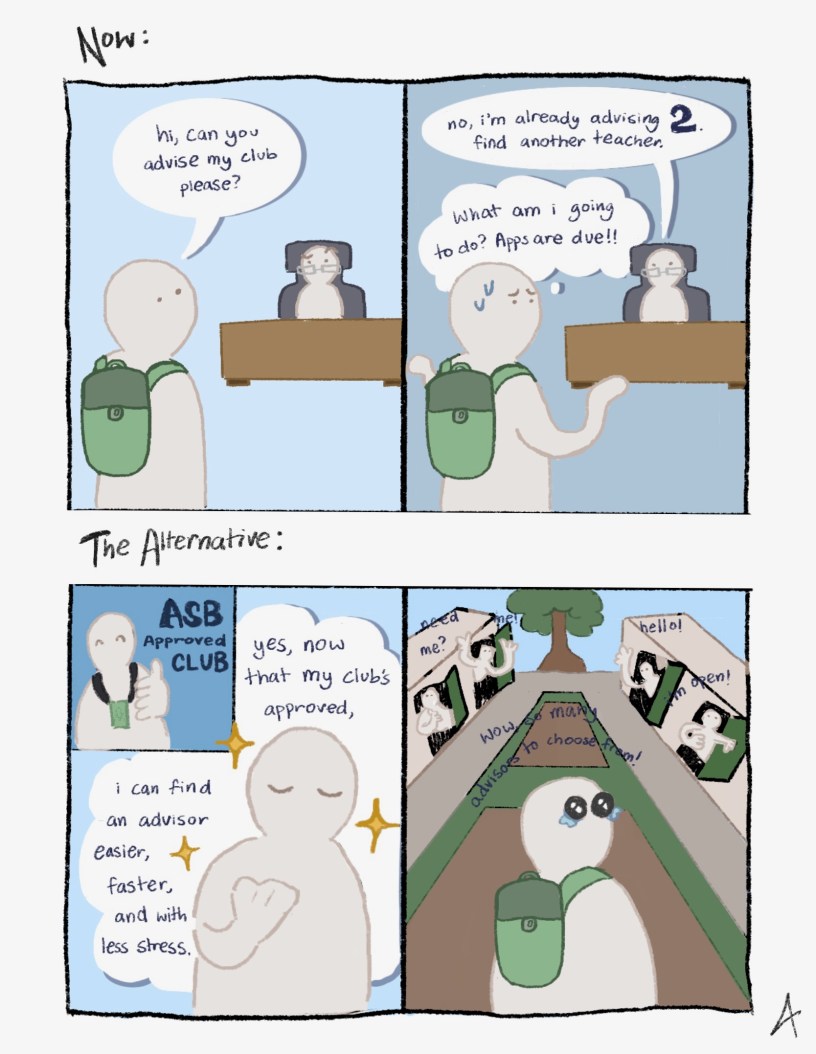
The current rule requires that students secure a teacher or staff member as an advisor before the Associated Student Body (ASB) approves their club application, putting unnecessary pressure on students hoping to create a club.
Asking a teacher to be an advisor for a club that hasn’t been approved yet creates an unnecessary hurdle. A student could spend weeks planning a club and finding a willing advisor, only for the ASB to deny the club in the end. Instead, the club advisor aspect of an application should happen once a club has been approved.
For perspective, last year, 190 clubs applied, and 80 were rejected. This means that dozens of teachers dedicated their time to clubs that ultimately didn’t even get the green light.
In her role as president of Project Dovi, a domestic violence advocacy club, Senior Chloe Han has first-hand experience with the club application process. She describes the scramble to find an advisor before the application deadline as a particularly stressful part of the process.
“During the craze of both electing officers and re-establishing the club, I faced problems in finding an advisor,” Han said. “Clubs that get approved should then be able to get an advisor because denied clubs leave the free advisor unable to take in a club, or otherwise having information about teachers willing to be advisors posted.”
ASB should first approve clubs based on the strength of the idea itself, without a requirement to acquire a teacher. Does the club have a clear purpose? Is there student interest? Does it align with school values? If the answer to these questions is yes, the club should get the green light.
Then, and only then, should the students be tasked with finding an advisor. This revised process should be a significant improvement for several reasons. It empowers students by putting the focus on their ideas, not on their ability to find an advisor who will host the club in his or her room. This approach respects everyone’s time and streamlines the entire process, likely leading to more successful and active clubs on campus.
Although the ASB Club Committee works hard to organize the approval process and communicate thoroughly with the administration, a new system could ease the burden on both students and teachers.
 The Plaid Press