By Viviana Morales & Chloe Hseih
We Should Stand:
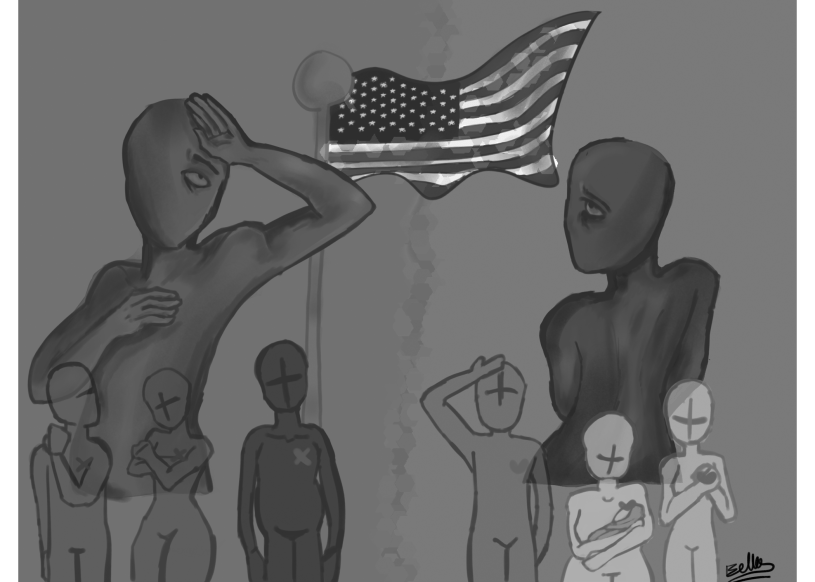
In our current politically-polarized society, no matter what side you agree with, there seems to be a major part of the nation you can’t reconcile with.
In times like these, second-period mornings mantras of our united, indivisible nation can seem pointless and strange.
Many in our student population stand for the Pledge of Allegiance. However, when those who stand are asked the simple question of “Why?” their answers are less than the picture of loyal and devoted citizens the pledge is aimed to create.
“Why do I stand?” junior Penelope Huh said. “Because everyone else does, I guess.”
This answer is repeated by most. The issue with our repetitive mantra is that for a majority of our students, it’s nothing more than a daily schedule of conformity and habit. Despite its words of loyalty to our nation, it rings hollow when students recite it only because they feel obligated.
In a tumultuous political climate and a government you disagree with, many feel it is meaningless to stand. However, that may be even more of a reason to recite the pledge.
“I say the pledge not out of devotion to my country, but out of hope for the future of the world,” junior Nola Lew said. “And also to inspire others to be hopeful too and stand with me.”
In a divided country, patriotism is hard to muster, but it serves a purpose greater than just motivating us to vote in our local elections.
Patriotism is a uniting force.
Not only that, but patriotism inspires us to stand for change. Standing for the pledge of allegiance doesn’t have to mean you think our country is perfect and the greatest in the world. It can be an action of hope, not necessarily for our country right now, but for what our country could be.
We Should Abstain:
A sign of patriotism and loyalty dating back to 1892, the Pledge of Allegiance has been recited in schools for over a century, although not always in the same form or with the same expectations. For many students, it represents the daily opportunity to demonstrate dedication to the nation. Or does it?
During the morning announcements every second period, students face a personal decision, whether or not to stand for the Pledge. Although once an unquestioned tradition, many classrooms now include students who remain seated, sometimes facing opposition. The Supreme Court ruled in 1943 that no student can be forced to say the Pledge, protecting their right to abstain.
“I think that students should have the right to not stand if they do not want to,” Mandarin teacher Dennis Wong said. “It’s the First Amendment right; freedom of expression. I don’t require my students to stand during the Pledge because of that.”
For some students, choosing not to stand stems from frustration with national issues. Concerns about inequality and social justice as well as political decisions leave many feeling disconnected from the Pledge.
Other students cite personal reasons. Students from immigrant families, for example, may struggle with pledging loyalty to a government that has enacted deportation policies targeting their communities.
“I do not stand up during the Pledge because I disagree with the actions that the President has taken in the past few months,” senior Rosha Mazdyasni said. “I believe that these actions are in total contrast to what this country stands for.”
With political protests rising among Generation Z, the choice to abstain from the Pledge can be seen as a part of a bigger movement and a demand for accountability from political leaders. Ultimately, standing for the Pledge may be a sign of patriotism for some, but for others remaining seated is its own powerful expression of democratic ideals.
 The Plaid Press