By Kai Bwor
Note: Spoilers ahead for Stranger Things Season 5.
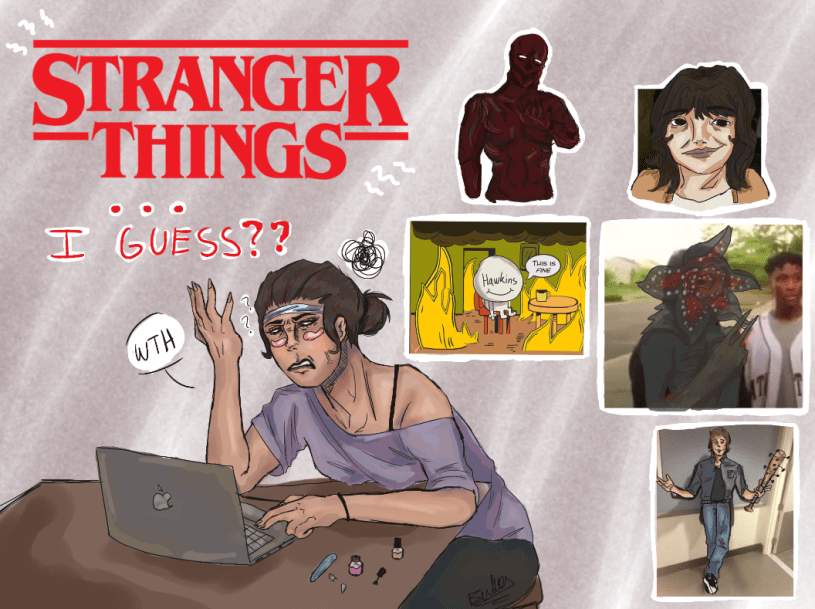
As a loyal viewer of the beloved Netflix series “Stranger Things,” I was so disappointed by the finale that I did what any reasonable fan would do and immediately turned to TikTok fan-fiction for emotional support. Yes, it got that bad. And honestly, I enjoyed the fan theories more than the actual ending.
Volume 1 was a masterpiece. The pacing was immaculate. It was bloody, gory, and genuinely frightening. I was sitting on the edge of my seat the entire time. The reveal of Will (Noah Schnapp) as the so-called “sorcerer” shocked me. Karen Wheeler (Cara Buono) swinging her trusty wine bottle while fully drunk? YES. I wanted more. I needed more. But then Volume 2 arrived, and everything went downhill fast.
Will’s powers, which were hyped up as if they were about to save humanity, barely did anything in the fight against Vecna (Jamie Campbell Bower), Henry, 001, or whatever name he was using that week. At this point, even he is probably confused. For all that buildup, Will mostly contributed emotional speeches and dramatic staring. And let us not forget Joyce (Winona Ryder), once a fearless mother who tore through dimensions to save her son, she was reduced to the overbearing mom stereotype. That role simply does not suit Ryder, especially after the powerful performance she gave in Season 1.
And the final battle was painfully underwhelming. The entire fight in the Abyss ended in what felt like five minutes. Honestly, it could have been an email. The Starcourt Mall fight in Season 3 had more energy, more chaos, and somehow more emotional weight than the literal end of the world. And apparently Vecna “likes it cold,” yet the Abyss is a desert that looks drier than Death Valley. Make it make sense. And where were the Demogorgons? They played a major role for four seasons and then suddenly vanished?
Part of the disappointment comes from the way the apocalypse teased at the end of Season 4 was completely ignored. The red lightning in the sky, Hawkins literally cracking open, the Upside Down bleeding into the real world—where did it all go? It looked like the end of everything, a true apocalypse. And then Season 5 arrives with a time jump, large metal sheets covering the cracks in Hawkins like some kind of grand construction project, and suddenly life goes on like nothing happened.
We should have been thrown straight into an apocalyptic Hawkins. No schools, no normal life, no pretending everything is okay. That theme would have been far more intense, far more emotional, and far more worthy of a finale. Instead, the show patched the apocalypse with sheet metal and moved on.
Everyone also had an alarming amount of character armor. The Duffer Brothers were clearly allergic to killing anyone off. There needed to be consequences, there needed to be loss. Yes, I like Steve Harrington (Joe Keery). You like Steve Harrington. Everyone likes Steve Harrington. But when nobody dies, the show starts to feel less like supernatural horror and more like a very intense group therapy session. At some point, it felt like the writers were afraid fans would show up at their houses with pitchforks and bricks plastered with Steve’s face.
And please explain this to me. A group of teenagers manages to defeat a nightmare monster and Vecna himself in about five minutes, while the United States military with trained soldiers and automatic weapons cannot do anything useful throughout their entire time in Hawkins. That makes no sense. While realism is not exactly a priority in a show with Demogorgons, alternate universes, and telepathic kids fighting monsters, lazy writing like this still hurts the story.
Then there is the play. Yes, there is apparently a “Stranger Things” Broadway play that contains important backstory. But why do I need to buy separate tickets and go on a theatrical sidequest to understand a TV show I have already watched for five seasons. Even as a full nerd who went through an 80s music phase and dressed the part, I am not nerdy enough for that. If Henry Creel’s background matters, it should be in the series, not hidden behind a stage curtain.
Finally, the fact that fans immediately began inventing theories about an alternate ending says everything. Some claimed the finale was a fake reality—known as Conformity Gate—created by Vecna to trap the characters. When viewers would rather believe the ending was not real than accept it as canon, something has gone terribly wrong.
The “Stranger Things” finale was not awful; it was disappointing. It was safe, predictable, and emotionally hollow. For a show initially built on fear, loss, and chaos, it chose comfort instead of courage. And that, more than any demogorgon, is what truly killed the magic.
 The Plaid Press