By April Anaya
Art comes in many forms, and is represented by various artists with diverse talents. Whether it is music, acting, or painting, art is a form of creative expression. Henna is a particularly unique art form that blends detailed illustration with body art, serving not only as creative expression but also as a tradition deeply rooted in cultural and ceremonial practices. detailed drawing with body art, turning the human body into a living canvas.
Henna, more formally known as mehndi, is a temporary dye made from the ground leaves of the plant Lawsonia inermis, and is applied to the skin, leaving behind a reddish brown tint that lasts several weeks. It is traditionally applied during significant celebrations such as weddings, religious holidays, and rites of passage. Although henna has become more visible in public spaces like fairs and theme parks, these modern settings exist alongside rather than replacing the cultural and ceremonial roots..
Henna is traditionally practiced in South and West Asia, as well as North Africa. Henna has grown in popularity as an artform worldwide, however, and is even widely practiced at our very own Granada Hills Charter (GHC). For many families and communities, passing down henna traditions is a way of preserving cultural identity and honoring history.
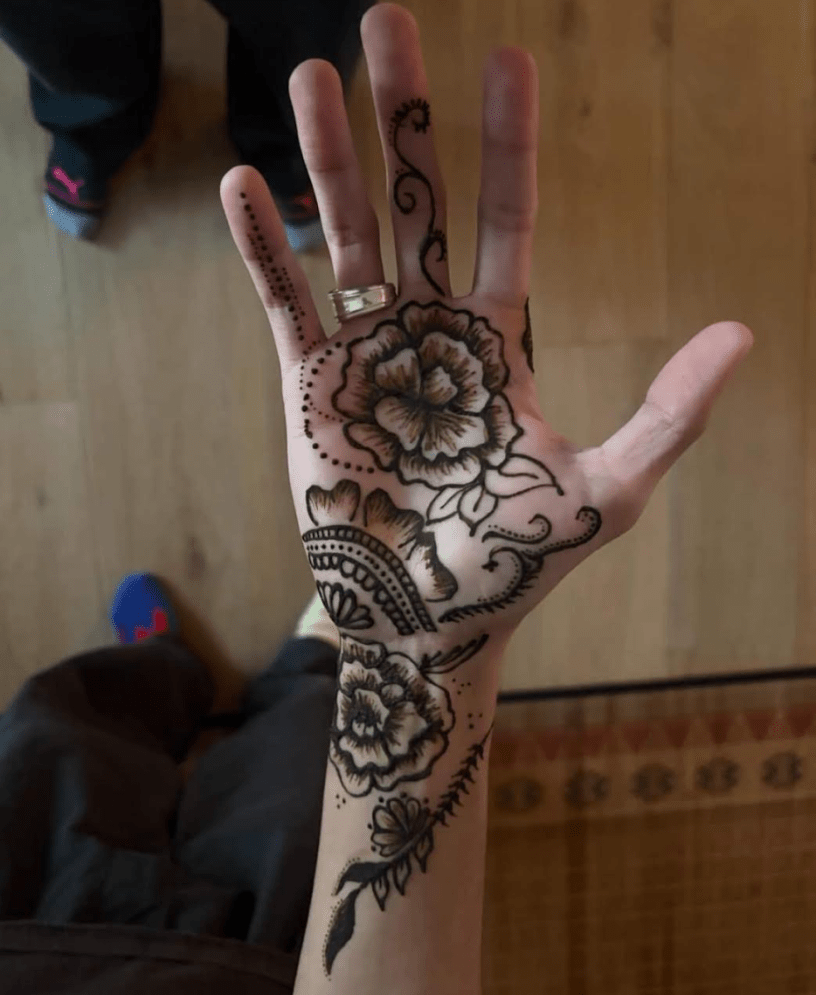
Senior Lali Bushey and junior Lola Davis-Stramat are two students who offer henna on campus, leaving friends with beautiful images of flowers, vines, sea animals, and more.
For some students, practicing henna is also a way to stay connected to family traditions.
“I first started doing mehndi during winter break of my junior year,” Bushey said. “When I was little, my mom would always do mehndi on me when our family was attending weddings, leading me to want to be able to do the same for her and my curiosity grew.”
The process of having henna done takes around 20 minutes to an hour depending on how intricate and large the design is. The design is placed on the skin using henna cones, which are small plastic bags resembling icing bags that allow the artist to pipe out the desired pattern with easy control.
“One of my favorite pieces that I have done so far was a freehand design on my friend’s forearm,” Davis-Stramat said. “She gave me complete creative freedom to draw whatever I wanted. It was especially enjoyable to be able to create such a large continuous piece.”
Although henna can be a creative outlet, it is also an art form that requires patience and respect for its cultural origins. Its temporary nature allows artists to practice and improve, but its meaning extends beyond beauty, representing tradition for many cultures.
Both Bushey and Davis-Stramat plan to continue doing henna in the future, hoping to improve their skills and be able to do more intricate art pieces. Both students find the art form to be a stress reliever, bringing them great joy and allowing their imagination to endlessly flow.
As henna continues to be practiced on campus, students like Bushey and Davis-Stramat demonstrate how traditional art forms can be honored and shared in modern spaces.
 The Plaid Press