What if a sport demanded the endurance of a runner, the strength of a gymnast, and the creativity of a dancer, all at once? Figure skating does exactly that, blending athletic precision with artistic expression in a way few sports can match. It requires intense discipline and years of training, making it one of the most demanding sports in the world.
The rink is a stage, a canvas, a podium for these athletes to express themselves and speak to their audiences. Ice skating holds a platform that on average reels in about 10 to 12 million viewers in the U.S. and over 2 billion viewers on a global scale. It is always one of the most-watched Olympic sports due to its emotional storytelling and visual spectacle.
Despite its graceful appearance, figure skating is far from easy. Skaters undergo intense physical training that includes leg strength conditioning, core work, and flexibility training, as well as endurance exercises. These elements are all essential to complete the jumps and spins that seem to push the limits of human ability.
One of the most difficult skills ever performed is the quadruple axle, a jump requiring 4.5 rotations in midair. The move was first successfully landed by American skater Ilia Malinin, and later attempted by Japanese Olympic champion Yuzuru Hanyu, highlighting the sport’s constant evolution and extreme difficulty.
Competitions are held year-round at the local, national, and international levels. In California alone, skaters participate in events such as the 2026 California State Games in San Diego and 2026 ISI Winter Classic in Valencia. Around the country, hundreds of teams compete annually.
The sport has a long Olympic history as well. Figure Skating was first seen in the 1908 Summer Olympics in London and has remained a staple of the Winter Games ever since. Unlike hockey or speed skating, athletes do not compete directly against an opposing team. Instead, skaters are judged on their individual technical skills, artistry, and overall performance. Although it is typically regarded as an individual sport, it also emphasizes team work with categories such as pair skating, ice dance, and synchronized skating.
One Granada Hills Charter (GHC) student who knows this first hand is sophomore Misha Reshamwala, a dedicated figure skater who trains at Iceoplex in Simi Valley. Introduced to skating at a young age by her parents, Reshamwala quickly developed a passion for the sport and has been skating for nearly 12 years. Her favorite category is synchronized skating, which combines teamwork with technical skill.
For students interested in starting figure skating, Reshamwala emphasizes the importance of patience and persistence.
“Learn all the basics,” Reshamwala said. “A strong foundation is essential. Also don’t become discouraged with challenges. Practice is the only route to learn or improve. Remember to enjoy it and celebrate every victory because they’re all accomplishments no matter how small.”
Reshamwala also emphasized that beyond competition, the skating community is a supportive environment.
“It’s very small and a lot of people know each other, even when competing— a very warm and encouraging environment,” Reshamwala said.
Though figure skating may not have a place on GHC’s athletic roster, it remains a powerful reminder that athletic excellence comes in many forms, some of which glide into the spotlight during times like the Olympics.
Ice skating requires balance of rigor with creativity
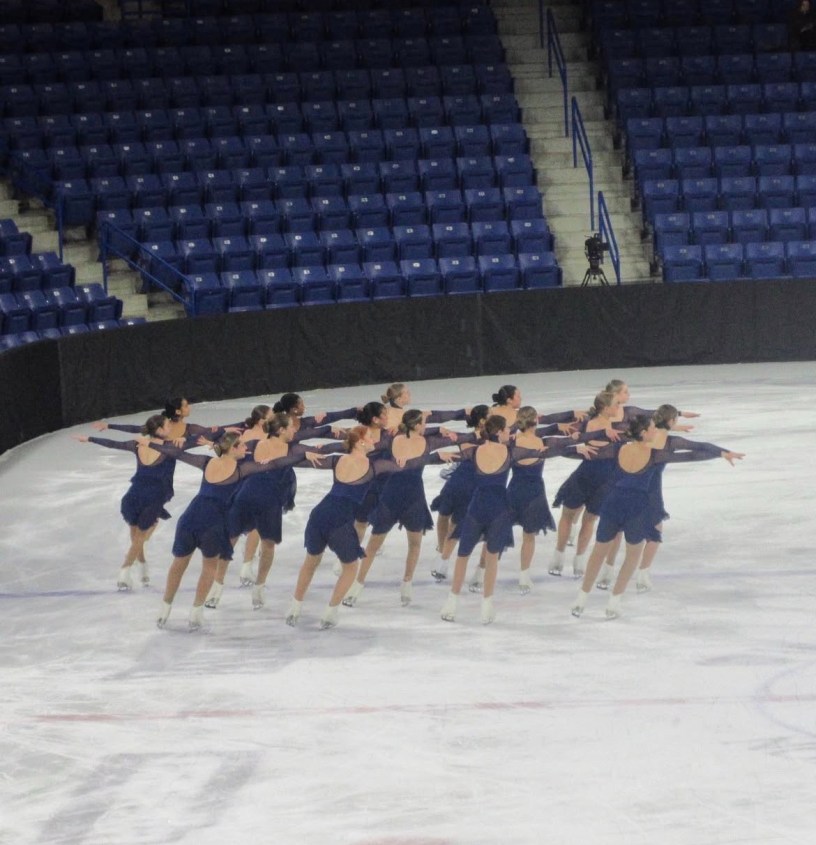
ON THE ICE: Sophomore Misha Reshamwala skates with her synchronized skating team. Photo courtesy of Reshamwala.
 The Plaid Press