By: Kai Bwor and Cooper Hofmann
Valentine’s Day is the only time of the year where the world collectively decides to experience life through a lens of artificial strawberry flavoring and the frantic, capitalist ritual of “emergency flower-runs.”
It’s also one of those holidays that people love to hate. It’s syrupy sweet, and everyone seems to be taken by this ravenous sugar high whenever it comes around. They make signs, buy flowers, and purchase enough chocolate to kill a small bear. Valentine’s Day collectively makes fools of us all, as we scramble to get the most perfect bouquets and claw at a crochet needle to make one of those fun little yarn flowers. The holiday itself comes with a plethora of expectations, mainly that everyone acts a little ridiculous. But, what’s the objective reality behind cupid’s day?
EXPECTATIONS:
We’ve been raised on the idea that romance is an instantaneous lighting strike. In an alternate universe, you lock eyes across the crowded cafeteria, the noise fades to a dull hum, and you just know, that’s the one! By the time the bell rings for fifth period, you’ve already shared this profound moment, and by the weekend, you’re a power couple. Fate does the heavy lifting, and the universe conspires to put you in the same lab group without you having to lift a single finger.
Fueled by decades of rom-com tropes and your “For You Page” flooded with meticulously staged videos of happy couples, you imagine turning the corner to find your significant other, surrounded by close friends and to turn it up a notch, possibly a few “jealous enemies” for extra flair. Your significant other is holding the ultimate prize of the 2026 season: a personalized basket, stacked with a couple of your favorite candies, a new Lego set to build together, your favorite niche candle, a sold-out Jellycat plushie, and a bouquet of roses, wrapped in that iconic Trader Joe’s brown paper bag.
The dream abruptly ends as the bell rings, and the “love-at-first-sight” fairytale dissolves into the cold atmosphere of 2026. In reality, this year, Americans are projected to spend a record-breaking $27.7 billion dollars, according to the National Retail Federation, to keep up their performance. But in the hallways of high school, where the average student is more likely to have a dead moth and a crumpled gum wrapper in their wallet than the $188.17 national spending average, the path to a relationship looks less like a rom-com montage and more like a high-stakes waiting game.
REALITY:
Love at first sight is a lot like Bigfoot: you can’t prove it exists, but you also can’t prove that it doesn’t. There’s no guarantee that the beating in your heart upon seeing a person from across the class isn’t something magical and divine and perfect.
The issue is, relationships move differently now. Sure, you can have that zing, a wistful glance from across a math class, but then comes the waiting. The words, “Can I have your Insta” hang heavy on the tongue, and then there’s the texting, asking for help with homework for an excuse to talk, but not too much because you don’t want to look like some psycho. No, you have to be nonchalant, the right amount of cool, mysterious, nice, mean, jaded, passionate, and casual, then you can move into the big leagues.
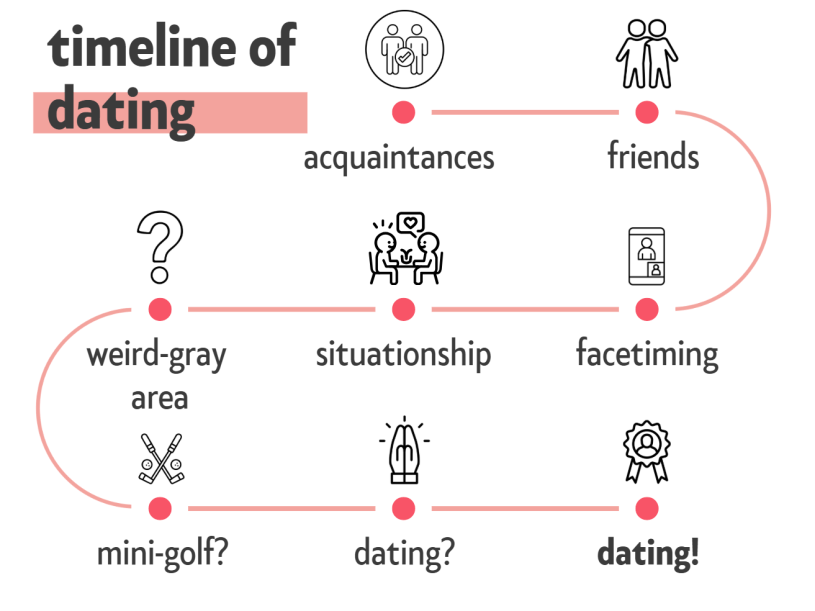
Today, even getting to an official relationship requires months of work. Though, a nifty chart may help one see the timeline to dating. (See the featured image)
The process of navigating this candy-gram minefield is long, arduous, and daunting. But, in the end, it’s worth it. You’ll walk into school excited, holding a glimmering bouquet, a skip in your step as you pass the million other folks all doing the same thing as you. In reality, it’s hard to find love. It’s hard to get into a relationship. Love isn’t an easy street to travel down, but that’s what makes it all the more worthwhile as you hand your partner a $20 box of chocolates on the day of St. Valentine.
 The Plaid Press