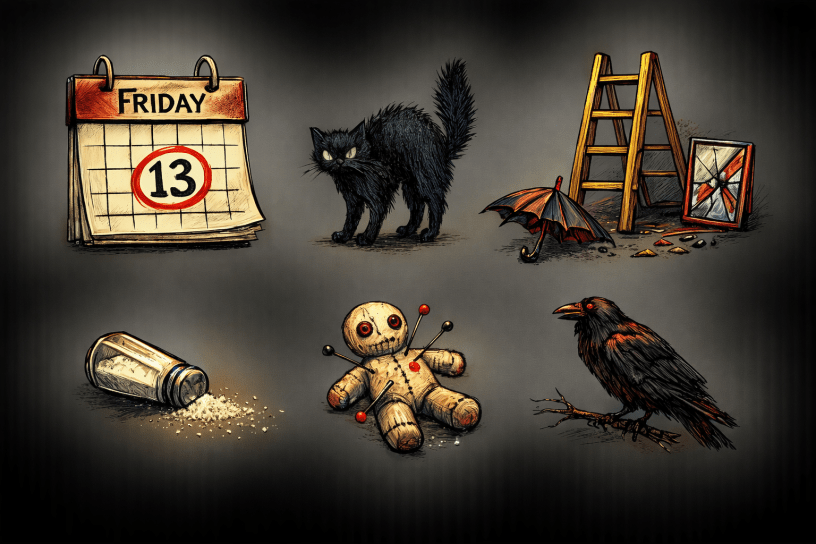
Today, February 13, marks an auspicious holiday on our calendars: the ever spooky Friday the 13th. The day has become legend, steeped in centuries of tradition and superstition. It has even spawned a movie franchise, further expanding its reach in western society and beyond.
For something so ubiquitous, its origins are not so clear cut. Scholars and historians have differing theories on how it came to be an iconic day.
One theory finds its roots in Christianity, where the number 13 is considered unlucky, as the apostle Judas was the 13th guest at the last supper and after betraying Jesus.
A similar story is found in Norse mythology, involving the trickster God Loki crashing a dinner party for the gods as the 13th guest, and ultimately causing the death of another major God, Balder.
It has been proposed that perhaps the numerical significance of the number 12 factors into it, widely seen as a “good,” useful number, notable for its use in measuring (time, distance, length) and the number 13 could be interpreted as a disruption of that perfection.
The significance of Friday as an unlucky date seems to have other religious origins as well, possibly due to its role as “Good Friday,” celebrated each year as a part of holy week to commemorate the crucifixion of Jesus. His death occurring on a Friday caused the day to be viewed as unlucky and tragic by Christians throughout history.
However, these theories don’t explain the relatively modern origins of the superstitions , which is believed to have first been referenced in French literature in the 19th century. It continued to be disseminated throughout the late 19th and 20th century, with multiple works in literature at the time referencing the date and its superstitious connotations.
In the modern era, the slasher film franchise “Friday the 13th” is often cited as a catalyst for the date’s current infamy in popular culture, spawning a whopping 12 movies, with a “Nightmare on Elm Street” crossover in 2003. For over 30 years, viewers watched the villainous Jason Voorhees scare his way from the infamous Camp Crystal Lake to a spaceship post cryogenic freeze (yes, really) arriving in the 25th century to a future where teenagers had just as little self preservation instincts as they did in the 1980s. As the movies traversed the path from low budget B-movie to campy, outlandish blockbuster, the date continued to cement its place in our culture and society.
Friday the 13th is not a traditional holiday in that there are not specific events that occur on the date, but it often brings with it a heightened sense of awareness for the superstitious, and some people will go out of their way to avoid other “unlucky” things, like black cats, walking under ladders, and breaking mirrors.
Unlike the date, many of these specific superstitions have known origins. We know black cats are considered unlucky because of their association with witchcraft, and certain sects of Christianity have have historically viewed them as witch familiars, a view which led to lasting avoidance in the western world.
Walking under ladders was originally considered unlucky for two chief reasons, one due to the triangle shape that is formed when one is leaning against a wall. Ancient Egyptian religion viewed triangles as symbols of the gods, and walking through one was seen as an affront. Similarly, Christianity interprets triangles as representative of the holy trinity, and walking through one was seen as “breaking” this trinity.
Secondly, there is evidence that executions by hanging in the middle ages contributed to the fear, as ladders were propped up in a similar fashion in order for the sentenced individual to reach the noose.
The superstition surrounding a mirror, namely that breaking one results in seven years of bad luck, can be tied to an ancient Roman belief that life renewed itself in seven year cycles. Cracking or breaking a mirror was considered unlucky because it was viewed as an extension of the soul, as one saw oneself within it. Breaking this was considered akin to breaking a part of oneself.
In today’s world, about 25 percent of Americans and 40 percent of Europeans consider themselves superstitious, according to a Gallup poll, a considerable amount for such a science-driven era.
It seems that in a modern world, superstition retains its ability to connect us across generations, and historical beliefs live on in traditions that define us even in the modern era.
Even if you do not sincerely believe today’s date harbors bad luck, the remarkable power of history and superstition has carried these ideas along for generations, connecting us to civilizations across time, from ancient Egypt and Rome to medieval Europe, Jerusalem to Valhalla, Salem to Camp Crystal Lake, and even the future.
 The Plaid Press