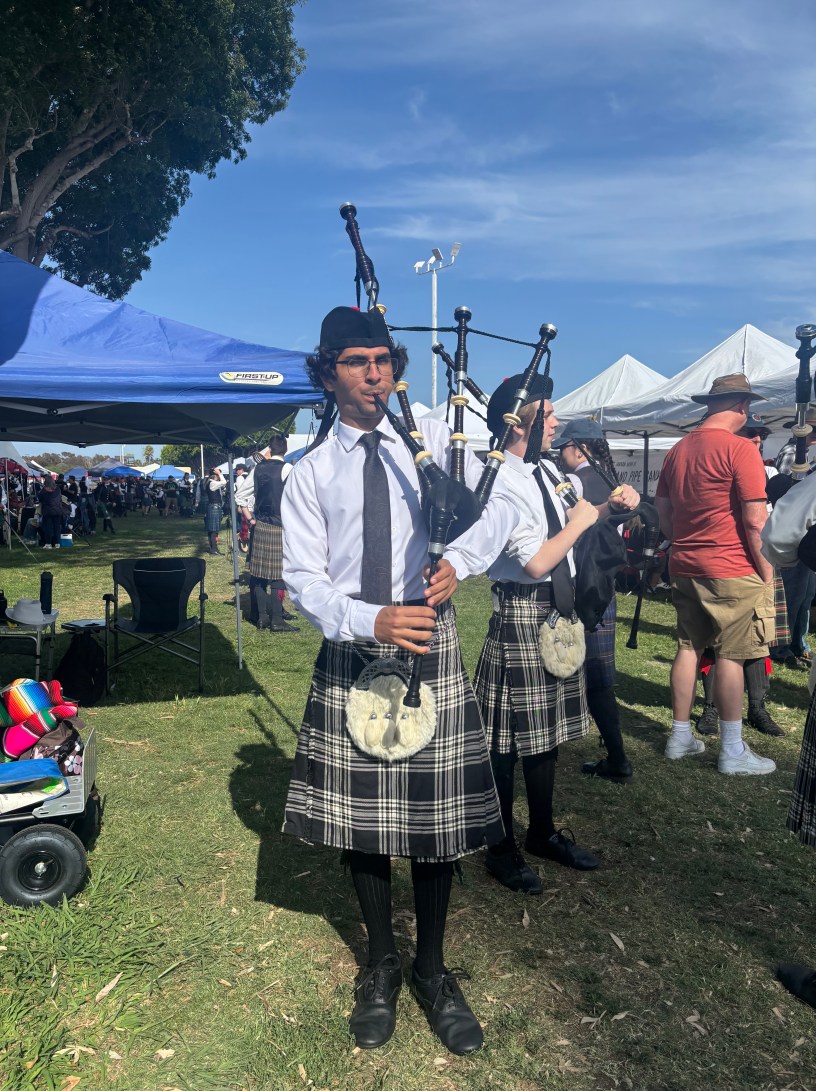
By Samantha Posa
In music, every instrument has its own unique identity. The bagpipes evoke images of a musician donned in a plaid kilt blowing on one of the four prominent drones while the sound echoes loudly around them.
Although the bagpipes are widely associated with Scotland, the instrument has much older roots. Early versions of bagpipes have been traced to ancient civilizations such Ancient Egypt and the Roman Empire prior to becoming connected to Scottish culture during the Middle Ages.
Today, bagpipes remain a popular instrument globally, including at Granada Hills Charter (GHC). Through the After Hours Activities (AHA) program, the students learn how to play the bagpipes, alongside lessons in snare, tenor, and bass drumming. The class meets every Tuesday from 3:30 to 5:30 p.m. Students also learn the culture and importance behind the art to fully immerse themselves in their playing.
Senior Amin Faal is just one of several AHA students who enjoy practicing their bagpiping skills every week.
“Since the school once had a pipe band, I always thought that playing the bagpipes would be a new experience,” Faal said. “When the AHA class started back up again last year, I knew I had to join.”
As a member of GHC’s marching band, Faal had prior music experience playing instruments such as the baritone saxophone for both jazz and wind ensembles. The unique nature of the bagpipes captivated Faal, inspiring him to start learning.
The unique design of the bagpipe is what garners the instrument so much attention, differing from its woodwind counterparts. The main bag serves as the primary air reservoir with four branching reeds that the bagpiper plays simultaneously.
Along with the unique design, playing the bagpipes comes with some technical differences. One difference between how traditional and bagpipe music is played is the timing of certain grace notes. In music, grace notes are small additional notes that enhance the overall play by adding extra melodies. They are typically played right before the main note in traditional music, whereas they are played on the beat when playing the bagpipes.
“For bagpipe music, it’s all about the style,” Faal said. “It’s an adjustment for sure, since it’s all in the small details.”
Since then, Faal and others hone their skills through consistent practice. However, the bagpipe class offers more than just lessons, also offering students avenues to showcase their progress.
Last year, AHA students attended Scottish Fest held at the Orange County Fair in Costa Mesa, performing numerous songs. Students also experienced other music and watched traditional Scottish dance. The group is set to attend this year’s Scottish Fest from May 23-24.
If you are interested in exploring the intricacies of playing the bagpipes, make sure to check out M16 and M17 every Tuesday.
 The Plaid Press