Most Americans have grown up drawing around our hands to make turkeys and coloring in cartoon images detailing the “first Thanksgiving.” We were fed ideas that the Thanksgiving holiday commemorates the European discovery of the Americas and the peaceful fellowship between the European explorers and Native Americans. However, that isn’t the full story of how Thanksgiving really came to be, let alone the full story of the interaction between the Europeans and Natives.
Initially, Thanksgiving had nothing to do with pilgrims. In 1789 the first Congress requested George Washington to dedicate a day to Thanksgiving and prayer for the new nation. Washington labeled November 26 as this holiday, and later congress dedicated more days to the same purpose, naming days in February in 1898 and April in 1815 to also be days to give thanks specifically to God.
Nevertheless, those days would just become a tradition since Thomas Jefferson refused to make this a national holiday, arguing that it was in defiance to the First Amendment and the division between church and state.
Fifty years later Abraham Lincioln famously made Thanksgiving a national holiday, proclaiming the last Thursday of November to be a national day of thanksgiving to the Christian God, but overall it was labeled as an effort to unite the country during the Civil War.
The story of pilgrims was not brought into the Thanksgiving narrative until the mid 19th century when Edward Winslow’s 1621 account of the Autumn harvest celebration between the surviving Mayflower passengers and the Wampanoag tribe became heavily circulated and eventually labeled as “The First Thanksgiving.”
In his letter Winslow describes the event to be somewhat of a blessing. He established that their exchange was nothing but pleasant, and a positive mutual exchange as a result of both parties’ inclination to do good.
“We have found the Indians very faithful in their covenant of peace with us; very loving and ready to pleasure us: we often go to them, and they come to us,” Winslow wrote.
In reality, the story of Thanksgiving differed for the Wampanoag completely, but that story was never circulated. Just like that, Thanksgiving was created to be a falsely romanticized recollection of the brutality of colonization and displacement.
The Wampanoag tribe had only come to that Thanksgiving feast as a desperate chance at survival. European diseases had ravaged Native American tribes ever since the Europeans had first docked their ships, killing hundreds of indigenous peoples. Even Winslow acknowledged this.
“The occasions and relations whereof you shall understand by our general and more full declaration of such things as are worth the noting, yea, it hath pleased God so to possess the Indians with a fear of us,” Winslow wrote.
As a result of that fear, they treated Winslow, as well as his fellow Europeans, with a surprising willingness to do whatever they could to please him. The settlers took advantage of the tribe’s vulnerability and later deemed that as consent for them to undergo colonization and created the idea of Manifest Destiny.
The stories of the Wampanoag were silenced, just as were the stories of those Taíno and Caribs people who are ignored in celebrations of Columbus Day. Contrarily, as human rights organizations grow in influence, society has slowly deviated away from Columbus Day for that very reason.
But if both holidays share the same type of background, what makes Thanksgiving different?
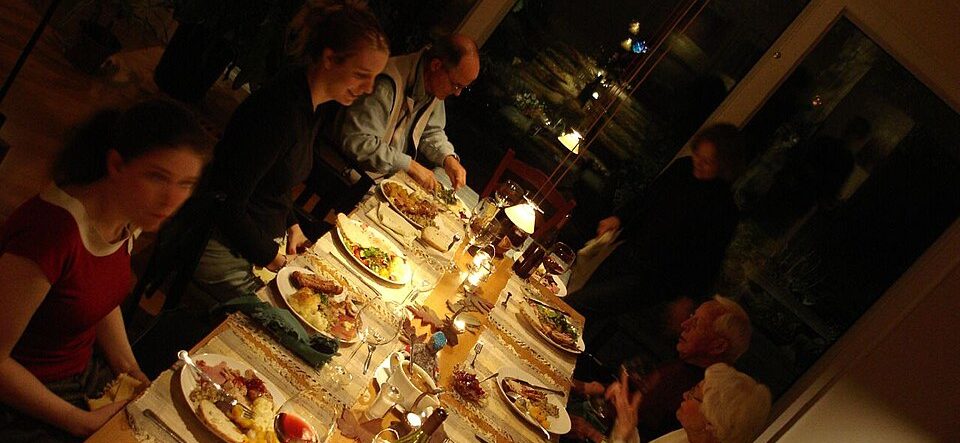
In short, Thanksgiving has survived because of how flexible the holiday actually is. This can be seen in holidays like Christmas which for many people has moved away from its religious origins. Thanksgiving has shifted to just another occasion to have a meal as a community just as Christmas has shifted to giving gifts to those you appreciate.
Although schools still choose to teach the false narrative of Thanksgiving to elementary schoolers, the problematic view of Thanksgiving will never really disappear.
Outside of the place it has in the social part of society, unlike Columbus day, Thanksgiving is a major contributor to GDP and the economy. Every Thanksgiving Americans spend roughly 2 billion dollars alone on food, according to Fox Business. Many people use the holiday as an excuse to travel to see their families, fueling more money into goods and services. Now along with Thanksgiving comes Black Friday and Cyber Monday, the total money spent in America “Thanksgiving weekend” is estimated to reach 160 million dollars this year.
By removing Thanksgiving as a national holiday the working class will no longer be able to celebrate the holiday since doing so will remove their days off. Fewer people will observe Thanksgiving, eventually leading to a decrease in consumer spending, and eventually lower the country’s GDP. Realistically, because consumer spending is such a heavy driving force of GDP, the government would not hastily remove such a large contributor, just like it won’t remove Christmas as a national holiday if something similar about its backstory would emerge.
Although Thanksgiving has a rough history, it still plays a large part of culture both in America and now in Canada. Instead of removing the holiday completely or recounting Thanksgiving for it being a symbol of the founding of America, the focus should instead be shifted. Instead of teaching children a glorified story of Europeans and Native Americans, it should live more by its name and follow its original purpose: giving thanks to the smaller virtues in one’s life.